Report: Defendant cannot be restored to competency
Staff photo / Ed Runyan
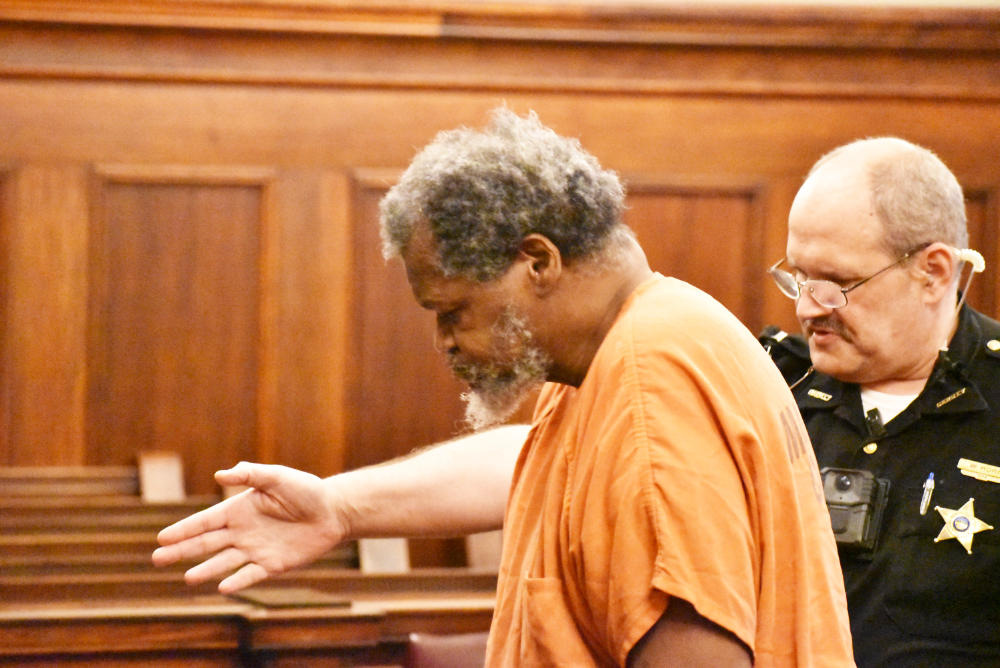
James Wesson, 65, of Youngstown, is seen being led from the courtroom after a hearing Wednesday in Mahoning County Common Pleas Court.
YOUNGSTOWN — The most recent evaluation of the competency of James Wesson, 65, of Youngstown, indicates he is not competent to stand trial on two felony charges and cannot be restored to competency within the time limits set by Ohio law.
During a hearing Wednesday before Mahoning County Common Pleas Court Judge Anthony D’Apolito, Katherine Jones, assistant county prosecutor, told the judge the parties have agreed to the findings of the new evaluation, which states that Wesson is “not competent and not restorable.”
In March, D’Apolito ordered that Wesson, 65, be taken to Heartland Behavioral Healthcare, a state mental hospital in Massillon, for treatment after forensic psychologist Dr. Robert Stinson found Wesson not competent to stand trial, but said he thought it was likely that Wesson would be restored to competency after getting treatment.
Jones said the prosecutor’s office will file an affidavit in Mahoning County Probate Court asking for civil commitment of Wesson. Under Ohio law, such a procedure is used to allege that a defendant is a “person with a mental illness subject to court order or a person with an intellectual disability subject to institutionalization by court order,” according to state law.
Wesson remains in custody pending civil hearings in probate court. Attorney Robert Harvey, who represented Wesson at the hearing, asked D’Apolito to rule that Wesson is not restorable to competency to stand trial within the amount of time required and to dismiss the charges against his client.
D’Apolito has 10 days to decide whether Wesson is competent to stand trial. If he finds that Wesson is not competent to stand trial, then he must rule on whether Wesson is a “person with an intellectual disability subject to institutionalization by court order,” the judge said.
The process of asking the probate court to decide on civil commitment means the probate court will decide if Wesson will be institutionalized, court officials said.
Wesson is indicted on felony charges of intimidation and retaliation, third-degree felonies punishable by about three years each in prison, as well as misdemeanors of assault, obstructing official business and disorderly conduct.
The charges stem from an incident Oct. 30, 2023, at a bank in Boardman, where Wesson was accused of assaulting a bank teller and then threatening Boardman police when they arrived to investigate the alleged assault.
Local News
Man indicted on kidnapping, rape and repeat offender specifications
YOUNGSTOWN — Sanjuan V. Smith, 57, was indicted Thursday on kidnapping with a repeat violent offender ...
Youngstown detective fired over unbecoming conduct
120 Years Ago, 1906 transcribed as originally published in the Youngstown Vindicator: “Moyer adjudged guilty; ...
YPD SWEARS IN 11 OFFICERS
Youngstown to shovel out $272,000 for clearing snow
YOUNGSTOWN — City Council will consider Wednesday permitting the board of control to pay $272,000 to contractors ...
On the record for March 14: Trumbull Career Center, Weathersfield Township trustees
Trumbull County WHAT: Trumbull Career & Technical Center board of education meeting Thursday The ...