Robotics competitions do more than create engineers, parents say
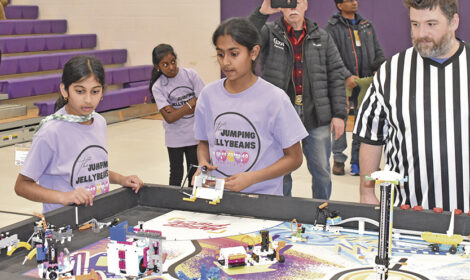
Staff photo / Ed Runyan Members of the Jumping Jellybeans, all-girl’s team from Aurora, are seen during their first competition Saturday at the district competition of the FIRST LEGO League Challenge at Champion Middle School. They are, from left, Nihira Teluru and Dhanu Vuyyuri. In the background is Riya Prathap.
CHAMPION — The community of the robotics-related FIRST LEGO League Challenge may seem like a place for kids laser focused on science and technology, but parents who have been involved say the skills kids learn are exceedingly more broad than that.
On Saturday, the junior high-level competition took place at Champion Middle School, where 25 teams from northeast Ohio competed in the district competition. Nine teams advanced from that competition to the state competition.
Jason Knaus, of Kirtland, a coach of the Kirtland Middle School team whose daughter and son participated, said the FIRST LEGO League puts an emphasis on teamwork and a concept called “gracious professionalism” — in which participants “compete intensely while treating each other with respect and empathy,” according to the organization.
“Working with teams, they get to see the dynamics of their kids with very strong skill sets in different areas, and they see that not everyone is great at everything. They learn to work together,” Knaus said.
The idea is reinforced by being judged not just on how well they have programmed their robot to perform on the robotics table, but how well they embody gracious professionalism.
Andy Yantes of Austintown, a wireless engineer for CISCO Systems, which makes the internet work on cellphones, is senior mentor for Ohio for FIRST LEGO robotics and was organizer for the event. He also mentors for the robotics program in Austintown.
In order to broaden the scope of the program, it added a new element this year. In August, the teams got a project with a theme of “Masterpiece,” which required them to select a hobby and come up with a way to make people interested in that hobby “the way artistic people get people interested in their art,” Yantes said.
The teams made a presentation to the judges on their idea before the robotics part began Saturday. For instance, one team picked crocheting as the hobby and wrote an app to show people how to crochet.
The “masterpiece” element nudges the competition in the direction of STEAM, instead of STEM, since STEAM stands for Science, Technology, Engineering and Math, whereas STEAM stands for science, technology, engineering, arts and mathematics, Yantes said.
“You don’t have to want to be an engineer to do this,” he said. “How many middle school students do you know who can walk into a room and talk to a bunch of adults about a project they made? It develops a skill early on where they are comfortable being able to communicate with people,” he said.
FIRST LEGO League does not teach a child how to engineer phone technology like Yantes does, “but the skills they are learning will translate later,” he said.
The robotics part of the competition involves teams building their robot and programming it to “perform missions on the robotics table,” Yantes said. They “score points by doing the missions around the table. They have 2 1/2 minutes to score as many points as possible.”
Some schools have multiple teams. There can be a maximum of 10 junior high kids on a team. Yantes had about 15 kids spread over two teams in Austintown this year, he said.
None of the teams from the Mahoning Valley advanced to the district level, so none of those teams competed Saturday in Champion.
Two kids are allowed to operate the robot per team during the table competition. The other kids stand back, but different team members can be switched in and out.
Yantes said kids have asked him when they are starting out for the “plans to build the robot. There are no plans. You have to imagine. You have to come up with that plan to build the robot to be able to do what you want it to do,” he said.
One measure of the impact FIRST Robotics has on kids is that parents frequently come to him to ask if they can buy a robotics kit “so they can do it at home because their kids get so into it. When the season ends, they don’t want to stop.”
A challenge is that a base kit is $400, and the LEGO mats and LEGOS cost at least $100.
“I’ve had kids take my robots home and play with them for a couple of months and bring them back because I know they don’t have the capability to buy it on their own,” he said.
He’s been involved in robotics for 13 years, since a daughter was a freshman at Austintown Fitch High School. “I’ve had kids who went many different directions. I had a student from my high school team that graduated last year and got a job with Bell Helicopter in Texas building military helicopters,” he said.
“I had daughters in the program, and my daughters, very smart kids, thought they were going to be engineers, went to college. My oldest is now doing medical billing, and my middle child is doing marketing,” he said.
Both daughters helped with the marketing for the robotics program. “They were writing the scripts, giving presentations for the robotics program,” he said.
David Blankenship of Kirtland, part of the Hungry, Hungry Hornets team, said he enjoys coding and building robots and “watching other people operate the robot. I enjoy the team work.”
His sister, Tabitha Blankenship, a senior in high school in Kirtland, said this is her seventh year in robotics.
“It got me an internship at Rockwell Automation” in Mayfield, where she works in “ethical hacking,” meaning testing products for security vulnerabilities so they can be eliminated, she said. She will be interning again with Rockwell this summer and is also working part-time there now while still in high school.
erunyan@vindy.com
Local News
Valley congressional races coming into focus
With the Feb. 4 deadline to file in partisan primaries quickly approaching, the races for the two U.S. House seats ...
City man helps a stuck driver

Storm is over, but frigid temperatures here to stay
Boardman road department earns praise for response
BOARDMAN — Despite Sunday’s heavy snow and Monday’s frigid temperatures, the business of Boardman Township ...
Canfield man faces felony domestic violence charges
BOARDMAN — A man is charged with felonies related to domestic violence after his wife showed up at the hospital ...