Pothole dispute heading to Ohio Supreme Court
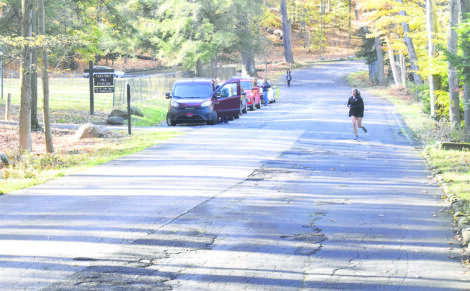
Staff file photo / Ed Runyan.... A young woman runs along Chestnut Hill Drive in Mill Creek Park in Youngstown. It is the area where a Boardman man was riding a bicycle June 22, 2019, when he hit a large pothole and fell, suffering serious injuries. The Ohio Supreme Court is being asked to review earlier rulings in the case. MetroParks says it is not liable for damages Bike rider says he was hurt on Chestnut Hill Drive
YOUNGSTOWN — Two years ago, a Boardman man filed suit against the Mill Creek MetroParks asking for damages because he was injured badly in an accident on a bicycle as he traveled on Chestnut Hill Drive in Mill Creek Park.
George Farris was biking to the Garden Cafe in the park’s Fellows Riverside Gardens to meet with his brother / business partner when he hit a pothole near Chestnut Hill pavilion and crashed to the ground.
Since the lawsuit was filed in Mahoning County Common Pleas Court, Farris and the MetroParks have debated the laws of Ohio. It is an effort to win a debate over whether Farris or others in a similar situation are entitled to damages when they are injured on a public roadway within a park, or whether the state’s recreational immunity statute protects the park board from such damages.
The case has now reached the Ohio Supreme Court, which has not yet decided whether to review the most recent decision in the case, which came from a panel of appeals judges from the Circleville area south of Columbus, which ruled in favor of the MetroParks in April.
Last week, the MetroParks filed its memorandum in opposition to jurisdiction in the case. The parks district told the state’s top court there is no reason for it to review the case because nothing about the issue is of “great public or general interest” or that addresses “novel questions of law or procedure.”
Attorneys Greg Beck and Andrea Ziarko of North Canton stated that the Ohio Supreme Court “has already determined the very narrow issue presented” by the case: “One who enters or uses municipal land, which is held open to the general public free of charge for recreational pursuits, is a recreational user” under Ohio law.
The Circleville appeals panel ruled correctly that the MetroParks does not “owe any duty to a recreational user to keep the premises safe for entry or use,” the MetroParks filing states.
CONFUSING RULINGS
Farris’ lawyer, Nick Cerni, argued in his filing last month, however, that there are “confusing and irreconcilable” rulings from various courts on “how and when” the state’s recreational immunity for government entities such as park districts should apply.
Farris, then 65, was wearing a helmet when the accident took place on June 22, 2019. Cerni argued that Farris was not a recreational user of the park the day of the accident because Farris was “riding his bicycle as a means of transportation and not partaking in any recreational amenities offered by the park.”
Chestnut Hill Drive is a two-lane road with a posted speed limit of 25 mph and is not part of the MetroParks hike and bike trail, the Farris filing states. The hike and bike trail is different from Chestnut Hill Drive in that the hike and bike trail has “bollards” that prohibit two-lane motor vehicle traffic, whereas Chestnut Hill has a northbound lane and a southbound lane that runs from near the Scholl Recreation Area on Bear’s Den Road to U.S. Route 62 at Lanterman’s Mill.
“Farris was not in an area dedicated to recreational use,” the filing states. “The roadway in question is unequivocally a public thoroughfare, and the park has a duty to maintain said road,” Cerni’s filing stated. As such, the parks’ recreational immunity does not apply, he argued.
RECREATIONAL USERS
But the MetroParks filing states that Farris “can point to no case that distinguishes between ‘travelers’ on the premises of municipal lands held upon the public free of charge for recreational purposes and ‘recreational users.'”
The MetroParks filing calls Chestnut Hill Drive an “unmarked, paved surface designed for multipurpose use by vehicles, hikers, walkers, joggers and other recreational users.” Farris “acknowledges that the accident happened within the confines of the park district,” it adds.
The roadway “is held open to the public for recreational use,” and the appeals court “correctly determined that the character of the property is consistent with the definition of ‘premises’ set forth in” Ohio law.
The law defines recreational “premises” as “all privately owned lands, ways, and waters, and any buildings and structures thereon, and all privately owned and state-owned lands, ways, and waters leased to a private person, firm, or organization, including any buildings and structures thereon.”
The law defines a recreational user as a person engaged in “recreational pursuits.”
The MetroParks filing states that “because the character of the property is consistent with the definition of ‘premises’ set forth in (the law) and because Farris was engaged in a recreational activity and was a ‘recreational user’ at the time of the accident, the (appeals court) correctly determined that Mill Creek is immune from liability” under the law.
RECREATIONAL ACTIVITY
Farris has said that he was not engaged in a recreational activity at the time of the accident, but he “drove to the park district, parked his vehicle in parking lot within the park district, took his bicycle out of his car and from there began riding his bicycle on Chestnut Hill Drive,” the MetroParks filing states.
“In fact, Farris’ decision to ride his bicycle through the park to his meeting instead of driving is a classic recreational activity.”
It added that rulings have indicated that it is not so important what a person is doing when they are in a park when determining whether he or she is a recreational user as much as the “character of the premises.”
A 1989 Ohio Supreme Court ruling involving the city of Dayton states that recreational immunity is warranted “whether the injury is to one who is jogging in the park, tinkering with a model airplane or reading poetry to satisfy a school homework assignment.”
According to a Frequently Asked Questions feature on the Ohio Supreme Court website, it typically takes three to six months from now for the Ohio Supreme Court to decide whether to review the case.
erunyan@vindy.com
Local News

Cockeye Creamery picks Gateways for new flavor

Strategizing continues in case of man who refused to testify at murder trial
Crash data reveal work-zone dangers
More than $137 million in construction work is about to get underway in Trumbull and Mahoning counties. Along with ...
Yost highlights Fife killing in report
Property transfers for April 4
Property transfers recorded March 23 to 27 in Mahoning County and portions of Trumbull County: Austintown ...