Court passes on MetroParks bikeways case
Sends bikeway issue back to Mahoning judges
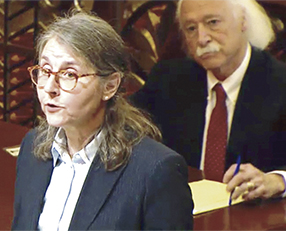
This image from the video of oral arguments in April before the Ohio Supreme Court shows attorney Elizabeth Farbman, who represents the Mill Creek MetroParks, answering questions and presenting information to the justices. Behind her is attorney Carl James, who represents Green Township property owner Diane Less.
The Ohio Supreme Court has returned to Mahoning County Common Pleas Court the dispute over whether the Mill Creek MetroParks can use eminent domain to take some Green Township property for the final phase of its bikeway.
The high court ruled that it does not have jurisdiction to decide the matter. And, its ruling states, the Mahoning Common Pleas judges did not conduct a hearing as required by Ohio law.
A common pleas court judge, under state law, must hold a hearing to determine the necessity for the MetroParks to take land from property owner Diane Less — before the issue is considered a “final, appealable order.”
The ruling, written by Justice Melody Stewart, states that because similar rulings by common pleas court Judges John Durkin and Maureen Sweeney leave “issues unresolved and contemplates further action,” the Ohio Supreme Court cannot rule on the issue.
It ruled that a panel of appeals court judge from Circleville in southern Ohio, who issued the most recent ruling in the case, also did not have jurisdiction when that panel ruled in favor of Less in the spring. That panel, hearing the case on assignment from the Ohio Supreme Court, ordered the case sent back to judges Durkin and Sweeney, but its ruling ordered the judges to dismiss the MetroParks’ attempt to acquire some of Less’ land.
The MetroParks, however, appealed that decision and the Ohio Supreme Court accepted the matter for review. The state’s top court ruled on Tuesday — a little more than three months after the attorneys for the MetroParks and Less made oral arguments in the case.
“We consider this a victory, and we will fight till hell freezes over, and then we will fight on the ice,” Less said, reached by telephone Tuesday.
She said she expects the case to return to the Ohio Supreme Court after Mahoning County Common Pleas Court handles it again — and wonders if this case will continue on after she is gone. Less said she is 69. “I’m just tired of it, and everybody else is tired of it, too.”
Aaron Young, MetroParks executive director, said of the ruling: “We are pleased that the Ohio Supreme Court unanimously sided with the MetroParks in this matter and look forward to continuing this process to bring additional recreational opportunities to the citizens of Mahoning County.”
THE RULING
The final phase of the MetroParks’ bikeway would be in the southern part of Mahoning County, connecting the current second phase at Western Reserve Road in Canfield Township and travel 6.4 miles south through part of Canfield Township and through Green Township to the village of Washingtonville at the Columbiana County line.
The bikeway would follow a former railroad bed now owned by Less and about 10 other property owners. If successful, the MetroParks would acquire 2 1/2 acres of Less’ land on the western edge of her property.
The ruling notes that after the MetroParks initiated the legal action in common pleas court in February 2019, Less and her attorney, Carl James, answered the lawsuit and “among other things, denied the necessity of the MetroParks to acquire a right of way on the property for an amount of money to be determined by the court, “as well as the park district’s authority to take private property for the purpose of creating a bicycle path.”
Less also argued that the park district “did not comply with the statutory requirements for initiating (such) proceedings,” called appropriation. Judges Durkin and Sweeney denied her motions for a decision short of a trial. Less appealed that decision, which resulted in the appeals court and Ohio Supreme Court decisions.
The high court’s ruling states that the provisions of Ohio law regarding the taking of land for public purposes requires common pleas court judges to “hold a hearing … to determine the (park district’s)” right to acquire the right of way and “necessity of the (land taking) when an answer is filed specifically denying the right to” take the land.
“Here the (common pleas judges) did not conduct a hearing as required” by Ohio law,” the Supreme Court ruled.
The appeals court panel gave a reason why it felt it was reviewing a final, appealable order, but the Supreme Court disagreed with that reasoning.
“We concluded that the (appeals panel in Southern Ohio) did not have jurisdiction to hear the merits of this case, and neither do we,” the Supreme Court ruled.
Local News

Cockeye Creamery picks Gateways for new flavor

Strategizing continues in case of man who refused to testify at murder trial
Crash data reveal work-zone dangers
More than $137 million in construction work is about to get underway in Trumbull and Mahoning counties. Along with ...

Yost highlights Fife killing in report
Property transfers for April 4
Property transfers recorded March 23 to 27 in Mahoning County and portions of Trumbull County: Austintown ...