

Speaker recalls introduction to segregated South
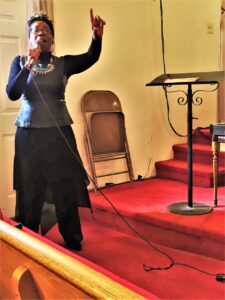
Correspondent photo / Sean Barron Stephanie White, who’s part of Beulah Baptist Missionary Church’s Praise Team, sings the William Becton song “Be Encouraged,” during a Black History Month event Sunday at the Youngstown church.
YOUNGSTOWN — The Rev. Artis Henderson recalled having taken a train to Tennessee during summer break one year when he was in grade school — and the rude awakening that followed.
“That was a moment in my black history,” Henderson, 61, who’s affiliated with Fellowship Tabernacle Christian Center in Youngstown, said.
Henderson was the guest speaker for a Black History Month program Sunday afternoon at Beulah Baptist Missionary Church, 570 Sherwood Ave., on the South Side. The nearly two-hour event also featured a variety of dances, poetry readings and songs.
Henderson recalled for an estimated 50 attendees that after his arrival in Tennessee, his grandmother instructed him to stay put before a white child approached and the two of them ran to look for the train’s engine. Henderson was certain his grandmother would be angry that he had defied her, but he learned later she was relieved because nothing had happened to him as a black child with a white peer in the segregated South, Henderson explained.
During his presentation, he also debunked the assumption some have that February was selected as Black History Month because it’s the shortest month. Instead, February was chosen because it’s the birth month of President Abraham Lincoln, who signed the Emancipation Proclamation on Jan. 1, 1863, and Frederick Douglass, a 19th century abolitionist, social reformer and orator, Henderson explained.
Nevertheless, it’s imperative that black history is remembered year-round, not just for a special day, week or month, he added.
In addition, it’s important for people to realize such history doesn’t stop with trailblazers and pioneers such as Harriet Tubman, Rosa Parks, Dr. Martin Luther King Jr., Marcus Garvey, Sojourner Truth and President Barack Obama.
“Black history is very much fluid and ongoing,” Henderson said, noting that each person has the power to contribute to it.
He pointed to Super Bowl LVII in which the Kansas City Chiefs beat the Philadelphia Eagles 38-35 on Feb. 12 in Glendale Ariz. However, the game’s unique element didn’t lie in the score.
“This is 2023, and we’re still making firsts. That’s black history,” the minister said, referring to the fact that it was the first big game with two black quarterbacks squaring off against each other –Patrick Mahomes for the Chiefs and Jalen Hurts for the Eagles.
Also during the program, several poems were read, including perhaps the most poignant being “Once Again,” by Gerald Lenoir and read by Elexis Buckley, a member of Beulah Baptist Church’s Angels of Praise.
The poem reads in part, “Once again, we pray, we march, we dissent/Once again, we rage, we cry, we vent/Once again, we ask: How can this still be?/Once again, we answer: White supremacy.”
The Rev. Jeffrey Stanford, pastor of Progressive Baptist Church in Warren, conducted a reading condemning the Jan. 7 beating of Tyre Nichols in Memphis, Tenn., in which five black former police officers are facing second-degree murder and other charges. Nichols, 29, died three days later from his injuries.
Too often, institutional racism is embedded in police culture, which goes a long way toward explaining why the accused former officers viewed Nichols “as a punching bag” instead of a human being, Stanford said.
In addition, America needs to admit its criminal justice system is broken, added Stanford, who also is a lead organizer with the Alliance for Congregational Transformation Influencing Our Neighborhoods (ACTION) organization.
Rose Wilkins of Beulah Baptist Church read aloud a brief backstory of Black History Month, noting that in 1926, historian Carter G. Woodson and the Association for the Study of Negro Life and History announced the second week of February as “Negro History Week” because it coincided with Lincoln’s birthday Feb. 12 and Douglass’s two days later.
In 1915, Woodson had participated in the Lincoln Jubilee in Chicago to celebrate 50 years since blacks’ emancipation from slavery.
In 1976, during the country’s bicentennial, President Gerald Ford recognized Black History Month, Wilkins noted. Ford encouraged Americans to honor black people’s achievements throughout history.
Musical selections included “Lift Every Voice and Sing,” which is the black national anthem, and the 1995 William Becton gospel song “Be Encouraged.”
news@vindy.com
Local News
Hubbard mayor updates council on Valley Mould Dam project
HUBBARD — Talks regarding the removal of a dam and sediment picked up in recent months, and the city’s mayor ...

Mother-daughter duo graduates from YSU on same weekend
Rep. Lauren McNally earns state award
The Ohio Healthy Homes Network named state Rep. Lauren McNally, D-Youngstown, as its legislator of the year for her ...
Two file as independent candidates
Two charged in Liberty domestic dispute
LIBERTY — A reported disturbance at an apartment complex resulted in the arrest of two Youngstown women on ...
Spring cleaning time for Austintown police and zoning
AUSTINTOWN — The township’s police department said it is taking residents’ springtime complaints ...