

Austintown school lauded for closing gaps
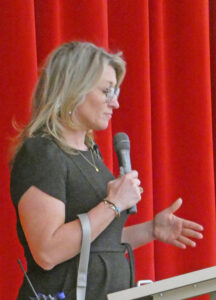
Staff photo / Emily Scott Austintown Intermediate School Principal Angel Owens congratulates her staff for being nationally recognized for closing the achievement gap among student groups. AIS is one of 55 schools across the country named 2022 National ESEA Distinguished Schools for the extraordinary success of their students
AUSTINTOWN — The staff at Austintown Intermediate School has earned national recognition for closing the achievement gaps among student groups.
The National Association of ESEA State Program Administrators recognizes schools across the country to mark achievements in three categories. The first is schools exhibiting exceptional student performance and academic growth; the second is schools that have closed the achievement gap among student groups; and the third is schools that show excellence is serving special populations of students.
ESEA, the Elementary and Secondary Education Act, was signed into law by President Lyndon B. Johnson as part of his War on Poverty. Title I under the ESEA was designed by Johnson to close the skill gap in reading, writing and math between children from low-income households and children from the middle class, according to NAESEA.
Austintown Intermediate School was recognized for the second category and is one of just two schools in Ohio recognized this year. The other is Mifflin Elementary School in Mansfield. The Austintown school is one of 11 Ohio schools asked to submit by NAESEA.
Fifty-five schools have been named 2022 National ESEA Distinguished Schools for the extraordinary success of their students across the United States. Only 14 schools were recognized for category two.
“I knew that it was special at this school and everyone works really hard,” speech language pathologist BeckyAnn Harker said. “It’s just really cool to be recognized for that.”
Superintendent David Cappuzzello, school board member Kim Smrek and AIS administration held a surprise ceremony for the AIS staff on Wednesday for the accomplishment.
AIS Principal Angel Owens said everyone in the building had a part to play in earning the award. She said it takes support at every level to help a child do well in the classroom and noted that every staff member knows every child is more than a test score.
“I do want to thank everyone in the building,” Owens said. “We have so many pockets of people. Everyone — it doesn’t matter what you do — everyone takes part in this. This is a very big deal and I want you to know that whether you are in the cafeteria or a custodian, an aide, a paraprofessional, a teacher, a counselor — it doesn’t matter. We all share in this award because everyone has their pocket of what they do for kids.”
CLOSING THE GAP
Owens said the school is able to close achievement gaps between students by following a Positive Behavior Interventions and Supports approach. A 2018 Ohio law requires each district to implement a PBIS framework, but Owens said it is so effective at AIS because of the staff.
“The culture here is special,” she said. “You don’t often find the desire to go above and beyond every single day, but that’s what we all do here.”
PBIS involves three tiers of instruction. Owens said it is like a plan that educators can follow.
Tier I will be effective for about 80 percent of students. It is a schoolwide, universal approach for everyone in the classroom. According to AIS resources, students learn basic behavior expectations, such as being respectful and kind. School staff regularly recognize and praise kids for good behavior. They may also use small rewards to encourage kids.
Tier II is an extra layer of support for kids who continue to struggle with behavior and in the classroom. At this tier, Owens said school staff does intervention with the child to see what they need to succeed. Some of this intervention can be done by the student’s teacher in the classroom, but part of the intervention is more individualized.
Tier III is the most intensive level and is for students who need individualized support and services because of their behavioral issues.
Owens said PBIS is targeted, focused teaching that’s inclusive for everyone and aims to bring everyone up to the same standard, thus closing the achievement gap.
AIS knows which children to target for intervention based on internal testing and record keeping.
She pointed out there are many factors that go into how a child behaves and performs in school, and AIS tries to address any of them. The school has a food pantry to help children struggling with food insecurity; tutors for children who would benefit from one-on-one help; and is part of a system in place if a child needs help at home.
escott@tribtoday.com
Local News
Big crowd expected Sunday for Big Boy in Struthers
STRUTHERS — The Union Pacific Big Boy is scheduled to arrive Sunday in the city’s downtown for what Mayor ...
Hubbard officials hear from engineer about data centers
HUBBARD — Officials and residents have shared their own experiences and research regarding data centers over the ...

Mahoning River seen as community connector
July 4 festivities end in arrest in Liberty
LIBERTY — A dispute between neighbors during Independence Day festivities became a brief standoff Saturday ...
Governor declares state of emergency for Mahoning
Progress made on problematic properties in Boardman
BOARDMAN — The township is seeing improvements in some of its sore spots. Properties that have stirred the ire of ...