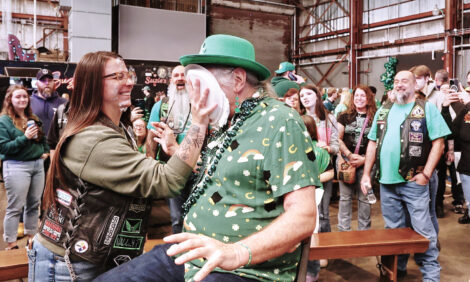
Veteran of Boardman sought action in Army

BOARDMAN — Roderick Hosler grew up as an Army brat.
His father was a colonel on Gen. Dwight D. Eisenhower’s staff and helped plan the Normandy invasion. He spent much of his childhood in Missoula, Montana. He attended the University of Montana and was in ROTC.
He graduated in 1972 and planned to be a teacher, “but I had to make a short stop in the Army and I just stayed.”
Vietnam was winding down, so he was sent to Fort Ord in California.
“Monterrey’s a nice place, but I wanted action,” so he volunteered to go to Korea.
He was stationed at Camp Walker in Teagu as an infantry officer. Two soldiers had recently been shot near the DMZ, so times were tense.
After two years in Korea, Hosler rotated back to the United States and became a parachutist with the 82nd Airborne in 1978. He made about 66 jumps, leading to “aches and pains, broken bones, dislocated shoulders and near misses but walked away.”
“There’s always some danger — bad winds, bad landing zones, mid-air collisions with other paratroopers, chute doesn’t open. We’ve had soldiers run over by tanks. My wife would say when she was with the Navy a ship would deploy and somebody would get washed overboard or go out for an evening smoke and never show up again. There’s no safe way to train. Every day you wake up is a good day.”
The Army needed a parachutist attached to the Navy so he was selected for the Atlantic Fleet Headquarters in Norfolk, Va. This is where he met Florence. In 1980, to be near his new wife, he transitioned to the Reserve. He became a technician writing training regulations. He was ready for a change.
In 1985, he was recalled into active duty as a full-time Reservist. He went to Fort Jackson in South Carolina as a budget officer for over two years.
“I contacted my personnel guys and said, ‘get me out of here because I’m vegetating.'” He ended up in Alaska, Massachusetts, Kansas, and even the Canadian Staff College in a military exchange program.
In 1990, Hosler mobilized troops in Desert Storm. He thought he would see combat, but it ended in a few days. While grateful for avoiding the horrors of war, this was like “training to be a surgeon and never getting a chance to operate.”
Hosler was promoted to Lieutenant Colonel at Forces Command Headquarters. He worked in mobilization getting units ready for assignments in Haiti, Somalia, Kosovo, and other “hot spots” until retirement.
In 1997, he finally began teaching. Youngstown City Schools needed an instructor for Junior ROTC. He interviewed with Superintendent Ben McGee “and was hired on the spot.” Their purpose was not to create soldiers but to help kids become better students and citizens. Unlike other classes, he didn’t need to spend all his time with, “Shut up. Sit down. Keep your hands to yourself.”
In 2000, he became an ROTC instructor at YSU. He has enjoyed watching people he taught rise to positions of authority in the military and prominence in the community.
In 2005, he retired for good, but retirement is a relative term for Hosler. In 2010, he became post commander of the American Legion in Poland. For 15 years, he volunteered driving veterans to Wade Park and Brecksville Hospitals in Cleveland.
In 2015, he became a commissioner for the Mahoning County Veterans Service Commission. They process claims and provide various types of assistance to improve the lives of veterans, families and survivors.
He is also the local and state president of the Military Officers Association of America. Its primary role is lobbying Congress to address issues such as substandard military housing, toxic burn pits and contaminated water at Camp Lejeune. With many soldiers enlisting who already have families, they battle the mindset, “You don’t have enough money — get food stamps.”
In his spare time, he is a military historian and has written articles for “On Point: The Journal of Army History,” including little known incidents such as the 25th Infantry Bicycle Corps of 1897 and American Intervention in Russia after World War I.
Hosler has lived in or visited every state in the U.S., as well as several countries in Europe and Asia and has friends almost everywhere. But he likes being settled in Mahoning County.
“This is a nice place. The weather’s decent. The folks are pretty friendly. The cost of living is reasonable,” he said.
Mostly he’s grateful to be an American for “the kinds of freedoms and opportunities we have here. I’m sorry to say most folks take it for granted. I can’t say much more than that.”
news@vindy.com
Local News
Saenger named new dean at YSU’s business college
YOUNGSTOWN — Youngstown State University has announced the appointment of Christina Saenger, Ph.D., as the new ...
Program peddles free bicycles in the Valley
High winds whip Valley, cause power loss to many
Heavy winds Friday and again Sunday caused many residents and some businesses in the Mahoning Valley to be without ...

Boardman goes green
Winning words pose no threat to regional spelling bee victor