
Science showdown: Top students from region compete
Trending
YOUNGSTOWN -- The number of students was down, but the level of curiosity from them remained high as several dozen students representing schools in four counties competed Saturday in the Lake-to-River District Science Day at the large gymnasium inside Stambaugh Stadium at Youngstown State University.
Those students receiving superior ratings from the teams of judges will move on to state competition in May in Columbus where they will compete for nearly $500,000 in scholarships and awards.
Michael Serra, associate professor of biochemistry and director of the Science Day event, said the low turnout may have been caused by it being the first live event in three years on campus. He added the snowy conditions Saturday morning may have hampered some participants.
"We are happy to be back in person; it looks like we will be easing back into this live event and next year we hope to triple the turnout," Serra said in explaining that Science Day gives students hands-on experience with the scientific method, exposes them to peer-review and provides a unique exposure to the campus.
Most of the projects displayed on the gymnasium floor dealt with an idea for a topic and a test of each participant's hypothesis or guess on what would happen in an experiment about the topic.
Dr. Felicia Armstrong, a member of the Science Day committee who led the judges in the workshop before the event, said the hypothesis needed to be tested at least three times for the student or team of students to get a superior grade (or 90 percent) to move on to state competition.
"But we want the kids first to have a good experience and afterward, we want them to say 'it was hard but I had fun,'" Armstrong said in telling judges to be the ones to "break the ice" with the nervous kids who are probably out in public for the first time in two years. "They are probablly going to be nervous to talk to adults because this could be the first thing they've done in years, literally."
THE EXPERIMENTS
Some of the experiments crafted by students included:
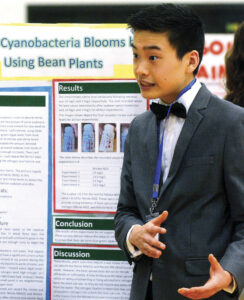
l Michael Ge of Boardman, a freshman at Ursuline High School, tried to see if regular soybean plants would halt the growth of cyanobacteria blooms on water sources. Ge said his testing didn't bring the desired results because the soybeans sucked nitrates out of the air faster than they could get them out of the water. "I'm not going to give up … I'll rework the experiment next year," he said. Ge said he got the idea for his project by walking his shepherd-mix dog near a creek in Mill Creek Park, and the canine ended up foaming at the mouth.
∫ Max Rossi of Warren, a fifth-grader from John F. Kennedy lower campus in Warren, said he was inspired by a kitchen spill to see which paper towel would be the "quickest picker upper." "I am a little nervous" he said, noting his test for three days in Feburary on spilled water showed the Bounty brand living up to its commercial pitch. Similarly, Max's classmate at JFK, Mark Honsaker, cooked up a "red butter" substance to see what was the best cleaner to wipe up a kitchen surface. "I found out that it was the Clorox cleaner," Honsaker said, noting he used Bounty paper towels as the control for his test.
∫ Several students used plants in their experiment. Riley Dietrich, senior, and sister Kaylee, a sophomore at Jefferson High School in Ashtabula County, said they wanted to know if classical music or heavy metal music affected the growth of house plants over a 10-day period. Riley said they played music in front of the plants for an hour eeach day. "We were supposed to see that heavy metal music made the plants grow more than the classical music," Kaylee said. In a similar vein, Howland senior Lukea Pitinii used a classical music mix, but changed the decibel level, for her experiment. She said the plants listening at 90 decibels responded better.
∫ Junior Taylor Baer of Howland High School took to the shores of Mosquito Lake in Bazetta last fall to see how the road salt runoff affected the wildlife in the reservoir. She said she could get good samples of minnows for her test, but ended up using the fish from a hatchery in Bazetta. She said the test provided a mixed bag as she conducted the experiment in a 55-gallon tank. "Their respiration would reach a certain level and then it would drop," Baer said about the results that showed the fish combating the effects of the salty mixture.
∫ Makaela Pippins, a fifth-grader at Valley Christian in Youngstown, made crystals out of a mixture of glue, salt and egg yolks. She said sea salt worked best as she separated the yolk from the egg whites with a straw. Classmate Armond DuVal titled his project, "Where Wild Things Grow," saying he was inspired by the COVID-19 pandemic to find the places in the home where germs grow best. "I found them mostly in the curves of the stairwells," he said.
JUDGING
The projects were being judged on oral, written and visual presentations, originality, the experiment and analytical data and how well the student knew the subject.
"You can tell that some of the younger ones have it memorized," Dr. Armstrong said, noting the scientific projects must follow the scientific method while the engineering exhibits have design / prototype model.
One of the judge captains, Richard Polenick of Warren, a former Delphi-Packard engineer who now works as technical manager for a specialty steel company in New Castle, Pa., said these students usually aren't the athletes "who hit the home runs or score the touchdowns."
"But they are very bright and some day, many of them are going to be future leaders of the community," he said.
Judge Kathy Salaka of Coitsville said she is happy to be going to a live event and enjoys seeing the team of students feed off one another's energy.
Armstrong reminded the judges to be positive in their first feedback on the scorecards, but "be generous in constructive criticism."
"We want the superior ratings to represent our area well in Columbus," she said, noting that the winners will have a chance to prepare for the virtual state competition at a workshop April 13 at YSU.
Winners also benefited from the prizes worth between $3,000 and $4,000 donated by over 30 area businesses including the main sponsors Altronic of Girard, IES Systems Inc. of Canfield, CJL Engineering of Youngstown, Buckeye Civil Design LLC of North Lima, and Mediate Financial Services Inc. of Canfield.
gvogrin@tribtoday.com