

Wild mustangs offer therapy to PTSD patients
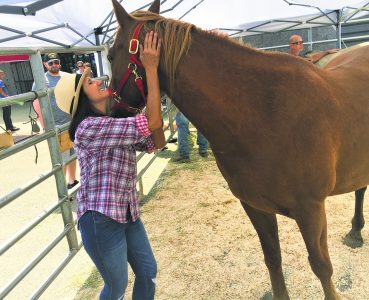
Madison Orlando of Salem, a certified equine therapist, hugs Gess, a Tennessee Walking horse, during an event Saturday at Youngstown Harley Davidson in Austintown. The horse, which lives at the DLR Mustang Ranch in Salineville where Orlando volunteers, is among those at the ranch trained to work with veterans who suffer from post-traumatic stress disorder. Correspondent photo / Sean Barron
AUSTINTOWN — The trauma of seeing a child, and others, die continues to haunt Dale Lackey, despite his best efforts to save her life and the passage of time.
“I had a 10-year-old girl who died in my arms from cardiac arrest,” Lackey, of Salineville, remembered about when he was an advanced emergency medical technician. “It still troubles me; I have nightmares. I still see the faces of a lot of patients I lost over the years, when I go to sleep.”
A saving grace for Lackey, however, is Sadie, one of the wild mustang horses that lives at the DLR Stallion Ranch in Salineville, which Lackey and his wife, Renee, own and operate. The center trains the animals mainly to help veterans and first responders who suffer from post-traumatic stress disorder and related challenges that resulted from their service to the nation.
Dale Lackey also served in the U.S. Army from 1980 to 1989, where he worked three years as a military police officer and seven years with the Pershing nuclear weapons system.
Sadie was among the horses that came to an event Saturday at Youngstown Harley Davidson, 5700 Patriot Blvd., to raise greater awareness of programs aimed at assisting such veterans.
The gathering also was to raise money for the first Horses for Heroes charity ride Oct. 17 at the business for the same purpose.
The nine-year Army veteran took a free six-week course in Granger, Texas, via the Mustang Heritage Foundation, which left a profound impact on Lackey and his family and provided the spark for him to launch a similar effort in Salineville for fellow veterans, he explained. While participating in the Texas program, Lackey selected Sadie from about 60 other horses, he continued.
“Sadie has taught me how to do it,” Lackey said, referring to helping him deal more effectively with his nightmares as well as anger and trust issues associated with PTSD.
Therapy horses are vital for many veterans who have emotional scars related to their service, partly because the soldiers are “trained to be a killing machine,” yet too often are not adequately able to return to family, jobs and other aspects of civilian life, Lackey noted.
Many wild mustangs that are displaced from their natural habitats and placed in unfamiliar settings suffer similar stress, anxiety and trauma as men and women who are removed from familiar surroundings, sent to the battlefield and experience difficulty re-entering society after their military service — which makes each able to relate to the other — Renee Lackey noted.
The mustangs are highly adept at reading the veterans’ body language and stress levels, so are effective in helping them communicate and “dial down” their feelings, she said. That’s vital, because many people with PTSD have an emotional makeup that operates a lot like a switch, meaning something as innocuous as a common smell or sound can trigger extreme rage, guilt or profound sadness, Lackey added.
“We have to earn their trust,” said Lackey, who added that the DLR Mustang Ranch has 23 equines, two burros, a mule and other animals all designed to help those with PTSD. “It teaches veterans to be aware of their body language in order to get this horse to accept you.”
She added that veterans who have the means to provide for the horses they worked with during the program the DLR Ranch offers are able to keep the animals afterward.
Madison Orlando of Salem, a certified equine therapist who volunteers at the ranch, noted that wild mustangs have a muscular structure similar to that of humans, but with little body fat. She uses massage and other soothing techniques to help the horses relax so they can be more effective with the veterans.
“It’s a win-win. Both learn to trust again,” Orlando said.
Also happy to lend a hand at the ranch is Katie Wease, 16, of Jewett, Ohio, who spent part of Saturday’s gathering grooming Gess, a Tennessee walking horse. She also expressed amazement regarding the horses’ ability to help those they are paired with to be more patient and better able to control anger.
“(Gess) is really good with everybody and likes a lot of attention,” said Katie, who called the ranch “my second home.”
Jacqueline Repomonto, Youngstown Harley Davidson’s events coordinator, said she’s grateful the business can be an additional resource to veterans in need. In addition, many of her customers served their country, and some also deal with PTSD, she added.
For more information about the DLR Mustang Ranch, call 740-491-7427, or email dlrmustangs@gmail.com.
news@vindy.com