
Trending
EDITOR'S NOTE: This is one in a series of stories on issues Ohioans say are most important in this election year. More than 50 news outlets are collaborating in the project under the umbrella of Your Voice Ohio, the nation's largest sustained, statewide news media collaborative.
When the casino where Jessica Hamilton worked shut down for three months due to the novel coronavirus, she filed for unemployment.
"I was on unemployment, which I never expected to be in my whole life," Hamilton said.
She wasn't alone. More than 1.6 million Ohioans filed claims with the Ohio Department of Jobs and Family Services during a 22-week period in 2020. That's one in five Ohio workers and more than the combined total claims from the last four years.
The sudden spike in demand stretched the already thin unemployment-benefits system past its breaking point. Low on money to pay the claims, short on staff to answer calls and suffering from aging software, the system struggled. Thousands of Ohioans tried for weeks to just hear a voice, let alone receive benefits for food, housing and health issues.
Deferred maintenance on the system that is supposed to be a safety net for Ohioans was one of several issues of long-term neglect or indifference raised by voters during a week of remote meetings with Your Voice Ohio, a project that connects journalists with voters from across The Buckeye State. People saw places where Ohio failed to invest when times were good only to find itself scrambling when the pandemic transformed these issues from disappointing to dire.
"I think it's been magnified, a little bit, by the pandemic because, I mean, let's face it there's a lot of people who have lost jobs, who have been laid off; a lot of people who have more pressing needs ... ," Worthington resident Dave Harliss said. "We have to have long-term goals as to how we are going to stay the best country in the world to live in, and if we don't, it won't happen. It maybe has become a little more urgent, but it's really no different."
PAID SICK LEAVE
For Hamilton, making it possible for people like her to stay home when they test positive for COVID-19 was one of issues she wanted addressed at both the state and federal level.
What can people do, Hamilton asked, when they have five days of sick leave but health officials recommend quarantining for two weeks. She wanted a real answer from politicians and "not just, 'Oh hey, your company will take care of that.'"
The federal Families First Coronavirus Response Act created emergency protections for certain private sector employees if they had to quarantine "pursuant to federal, state, or local government order or advice of a health care provider." But the bill didn't include employers with more than 500 or less than 50 employees.
At the state level, Ohio's Republican-controlled legislature left paid sick leave provisions out of its own coronavirus bill passed in late March.
"There really is nothing for her to do, and that's a horrible answer for me to give as a politician," House Minority Leader Emilia Sykes, D-Akron, said after hearing of the dialogues. "These are impossible choices that folks are left with."
About 90 percent of Americans admitted they go to work sick some of the time, according to an October 2019 survey by the global staffing firm Accountemps. And 33 percent reported always going when they were "under the weather."
"They can transmit diseases. They can make themselves sicker for fear of not having any paid sick time," said Gladys Pope, an elementary school secretary from Cincinnati. "I know the pandemic has sort of pulled back the cover on that initially, but I feel like that kind of has gotten buried under the economy and vaccines. I think that's a conversation we need to pull back to the forefront."
HOUSEHOLD INCOMES
Ohio's unemployment had dropped from 5.2 percent when President Donald Trump took office to 4.1 percent before the pandemic, according to state labor statistics. But job growth had slowed in the kind of blue-collar manufacturing jobs the president promised voters. In fact, Ohio manufacturing jobs plateaued one year into his first term and were in a downward trend before the pandemic, according to seasonally adjusted data from the Bureau of Labor Statistics. Some experts predict the state will lose another 40,000 manufacturing jobs (nearly 6 percent) by 2026.
"I came here to Cleveland in 1991 as a result of the steel industry disappearing in Pittsburgh," Richard Madonna said. "The one thing Pittsburgh has done is they've revitalized it. They tore it down and started over."
But Madonna sees abandoned mills decaying throughout northeast Ohio. Cleveland now ranks as the 5th fastest shrinking large city in the U.S., and the state as a whole is expected to lose at least one congressional seat after the 2020 census.
"I think for a lot of Ohio's history our economy has been fairly reliant on certain industries such as manufacturing," said Spencer Fritz, a student at Sinclair Community College. "So, when the economy has gotten bad and we've lost many of our manufacturing jobs, we're in a position where we are not able to recover as easily."
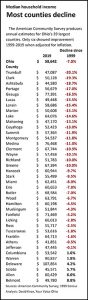
Ohio's median household income peaked in 1999 at $63,041 a year when adjusted for inflation, according to data obtained by Your Voice Ohio. Today those households makes about $5,000 or 7 percent less.
Trumbull County leads the statewide loss list with a 20.1 percent decline over a decade, with median household income standing now at $47,087, according to the data. Mahoning is 10th with a 13.1 percent decline and a median household income of $47,170. Ashtabula is third on the list with an 18.7 percent decline and median of $44,580; Columbiana is 34th with a 1.6 percent drop at $53,542.
As for Pope's home county, Montgomery County at 13th declined 11.8 percent since 1999 with median household income now at $54,537.
And Ohio has tumbled in relation to the nation. In 1999, median household income was about 2.4 percent below the U.S. median, but by 2019 the gap had more than tripled to 9 percent.
Fritz wanted to see more jobs in STEM fields like medical technology and engineering come to Ohio.
"I think what's best for our economy is to be able to have more options, to diversify," he said.
COST OF EDUCATION
Madonna and others were quick to point out that luring companies to Ohio would require a labor force with the skills to fill those positions. But both Ohio and the U.S., they said, haven't done their best to de-stigmatize a trade school education or make college more affordable.
Most Americans (61 percent) wrongly believed state spending for public universities and colleges increased or held steady from 2008 to 2018, according to an American Public Media Survey.
In reality, the Center on Budget and Policy Priorities found U.S. states collectively spent about $9 billion less than they had in 2008. Ohio was no exception.
As an example, Sykes said it was cheaper for her to get a law degree from the University of Florida than it would have been at The Ohio State University. And that's problematic for a state that wants to keep its talent at home.
More than 40 years ago, Ohio subsidized about two-thirds of the cost of college. Today, it's far less.
For example, in 1965, a person could work 21 hours a week at minimum wage and have enough to pay tuition, room and board at a state university. Today, a person must work 65 hours a week at minimum wage, every week, no vacations, to afford the same, according to Your Voice Ohio calculations.
It's hard to focus on school, Fritz said, when you're worried about how you'll pay off loans for the rest of your life.
HOW TO PAY
Deferred maintenance in a home, a city or even the state legislature often happens because people simply lack the money. And borrowing during a crisis - while sometimes necessary - can push items like fixing a leaky sink further down the list.
But governments also have the power to change their income, and often do so for the programs lawmakers choose to fund, such as a recent gas tax increase for highway construction.
The unemployment fund is supposed to be self-sustained through payroll taxes, but federal regulators say Ohio hasn't met the minimum requirement of a year's worth of reserves since 1974. Twenty-nine other states hit that minimum between the Great Recession and the pandemic. Ohio did not.
"You know, you just don't print $1 trillion ... ," Madonna said. "If you listen to the radio at all, doesn't matter what station you listen to, the national debt for the year has as already overcome the GDP. We've got to pay the piper. We've got to get through this. We've got to help our brothers and sisters, but it's really going to hurt us in the future."
COMING MONDAY: Challenged by uncertainty, Ohioans become creative, and find hope in new ideas.