

Election delay prompts number of ballot questions
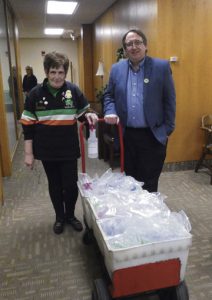
The boards of elections in Mahoning and Trumbull counties were swamped with calls Tuesday with people asking questions about the delayed primary election — and there weren’t a lot of answers to give.
Also, several election workers and voters showed up at polling locations not knowing that Gov. Mike DeWine had Ohio Department of Health Director Dr. Amy Acton declare a public health crisis late Monday. She ordered the polls closed as a health emergency because of the COVID-19 outbreak. The new primary election is June 2.
“In my 31 years at the board, I’ve never experienced anything like this before,” said Joyce Kale-Pesta, director of the Mahoning County Board of Elections. “We were very surprised by the lack of communication. We wouldn’t have been able to have an election if they said it was OK because we were in limbo. All of the other counties, too, were waiting.”
Operating on two hours of sleep Tuesday, Stephanie Penrose, director of the Trumbull County Board of Elections, said, “It’s unprecedented. There’s nothing to go on here. It’s all fresh material. We’re asking for some patience.”
Thomas McCabe, deputy director of the Mahoning board, said, “We were caught flat-footed by the announcement.”
What is known is people who haven’t requested absentee ballots can do so between now and May 26. If completed ballots are mailed to boards, they must be postmarked by June 1 and received no later than June 12 by mail. They also can be returned in person to the board by June 2.
The plan is for polling locations to open for voters between 6:30 a.m. and 7:30 p.m. June 2.
ELECTION RESULTS
But it might not be until July 3 that the results of the primary are certified, according to a directive from Secretary of State Frank LaRose.
LaRose said the official count of the election may begin June 23 and must start no later than June 27 with certification no later than July 3.
There will be no extension to register to vote for this primary and no additional in-person voting hours, LaRose said.
The Ohio Democratic Party wants the primary conducted earlier and on Tuesday filed a writ of prohibition with the Ohio Supreme Court seeking to ensure the primary election will take place.
The court action proposes a “more workable window for the election to take place along with multiple opportunities and a reasonable amount of time for voters to vote,” party Chairman David Pepper said. The party seeks to move the election to April 28.
To inform voters that there wasn’t an election Tuesday, Mahoning election officials put up signs at the county’s 70 polling locations around 8 p.m. Monday, McCabe said. If the election was going to be held, pollworkers — who arrive at the locations at 5:30 a.m., an hour before voting was to start — would have taken the signs down, he said.
In Trumbull, Penrose said six staff members went to the 55 polling locations in the county at 5 a.m. Tuesday to put up signs about the election being postponed.
Trumbull officials are considering the possibility of paying its pollworkers for Tuesday while those in Mahoning will receive $25 each.
Election employees in both counties picked up most of the election equipment Tuesday from the polling locations and brought them back to the board offices.
Because of the virus, election officials had urged people to vote early either by mail or in-person at boards of elections.
The number in Mahoning was up from the 2016 primary — largely because of the virus concern, election officials said.
In Mahoning, 14,436 people voted absentee compared to 11,929 in 2016.
In Trumbull, 9,729 voted absentee compared to 9,577 in 2016 .
Asked how the delay will impact turnout, Penrose said, “I can’t even predict that. The delay has hyped the election so it could be greater turnout. But people could be turned off and could decide not to vote.”
VODKA AS A DISINFECTANT
Both county boards had cleaning supplies ready for polling locations.
Mahoning had ordered 202 bottles of 32-ounce hand sanitizer weeks ago from Staples, but the company couldn’t fill the order.
So Kale-Pesta said she created a homemade version from a recipe she read online. She purchased 16 bottles of 153-proof vodka, 16 gallon jugs of distilled water — costing a total of $336.18 — and geranium essential oil she already had. Using eight cups of distilled water and four cups of vodka with 25 drops of the oil, Kale-Pesta made 75 spray bottles of hand sanitizer. Each of the county’s 70 polling locations were to have a bottle with a few left over for the board office as backups.
She noted it was cheaper than purchasing hand sanitizer if it was available.
Penrose made “care packages” with paper towels, disinfectant spray, alcohol wipes and alcohol-based cleaning spray for each polling location.
Local News
Officials push back on water regionalization
NILES — City officials expressed concerns about how a meeting regarding one of the city’s resources was ...

St. Baldrick’s Shave hopes to raise $91K

Ex-receiver seeks $80K for his work with troubled SOBE
Lordstown students gain skills through carpentry
Couple fights for clarity, safety of Canfield creek
Puddlers at Republic Iron & Steel went on strike for rule change
120 Years Ago, 1906 transcribed as originally published in the Youngstown Vindicator: “Puddlers are on a strike. ...