Selma: 55 years later
Black History event welcomes rights activist
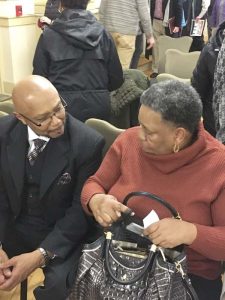
Correspondent photo / Sean Barron Joanne Bland of Selma, Ala., speaks to the Rev. Kenneth L. Simon of New Bethel Baptist Church after her presentation Thursday evening at the Tyler Mahoning Valley History Center in Youngstown. Simon said he found the civil rights activistás talk on voting rights to be inspiring and timely.
By SEAN BARRON
Correspondent
YOUNGSTOWN — Joanne Bland got emotional when she flashed back to the day, more than 50 years ago, when she looked through a window at Carter’s Drug Store in Selma, Ala. and knew she was not allowed to sit on the stools around a lunch counter.
“My grandmother told me, ‘When we get our freedom, you can sit at that counter,'” recalled Bland, 67, a civil rights activist who still lives in Selma.
She was forbidden to sit there because, like so many businesses in Selma and across the Jim Crow South in the mid-1960s, the store was segregated, she told an audience of 162 who heard her speak Thursday evening for a program called “Selma: 55 Years Later,” at the Tyler Mahoning Valley History Center in downtown Youngstown.
Sponsoring the free event were Mahoning Valley Sojourn to the Past, the Martin Luther King Jr. Planning Committee of Mahoning County and the Mahoning Valley Historical Society.
Preceding Bland’s presentation was the showing of “After Selma: The Fight for the Right to Vote Continues,” a new documentary that traces the numerous ways many states have suppressed and diluted voting efforts — all of which disproportionately affect people in minority communities — since the Voting Rights Act was passed Aug. 6, 1965.
“It makes me sad, after watching that film,” she said.
Bland explained that her childhood was marked by forays into the civil rights movement, including when she joined the Student Nonviolent Coordinating Committee at age 11. She also was influenced by Amelia Boynton and her husband, Sam, Selma activists who formed the Dallas County Voters League in the early 1930s because they “realized that if you could vote, you could change laws,” she remembered.
For her early activism, Bland, a U.S. Army veteran, was arrested 13 times — the first time at age 8 — and sometimes was in a small cell with 20 to 40 people and served food that consisted of “dried beans and peas,” complemented with rocks and insects, she said.
Nevertheless, Bland eventually became steeped in the concept of nonviolence, which was severely put to the test on March 7, 1965, when she was on the Edmund Pettus Bridge in Selma with about 600 other marchers, many of whom were beaten, clubbed and subjected to a highly noxious form of tear gas by Alabama state troopers on a day infamously known as “Bloody Sunday.” Among those who suffered injuries was her 14-year-old sister, Linda, Bland recalled.
“We met a wall of policemen,” she said, referring to the line of Alabama state troopers on the other side of the bridge.
“(The attack) seemed like an eternity,” said Bland, who also vividly recalled the sound of a woman’s head striking the pavement nearby. “They were just beating people, black and white, male and female, it didn’t matter.”
News of “Bloody Sunday” also outraged many around the world and was pivotal in the passage of the Voting Rights Act, many historians contend.
In early 1965, Dr. Martin Luther King Jr. helped to spearhead voting-registration efforts in counties around Selma, known as the “Black Belt,” which was met with resistance from many racist whites. The Rev. James Orange, one of King’s aides, was arrested in nearby Marion County and had a noose slipped over his cell, which led to a night protest Feb. 18, 1965, that resulted in the killing of a black man named Jimmie Lee Jackson, who was shot to death by a state trooper while protecting his 82-year-old grandfather, Cager Lee, Bland explained.
Despite gains in voting rights and other progress, Selma today continues to struggle with urban decay, the effects of white flight, job losses and deteriorating neighborhoods, she told her audience.
Nevertheless, it’s imperative that people continue to fight for voting rights and engage in forms of activism that challenge the status quo. Everyone has the potential to make a difference and should not underestimate their value, Bland added.
“A social movement is like a jigsaw puzzle,” she said. “Everybody is a piece. You’re the most important piece.”
The film dissected the modern means to suppress voting rights and disenfranchise millions of mainly minority people via gerrymandering, intentionally moving polling places, mass incarceration, states’ strict voter ID laws and fictitious claims of massive voter fraud.
Local News
Man gets 2 to 3 years for 2024 assault on woman
Hubbard council hears request for fire building support
HUBBARD — One official said city council will have a meeting to discuss its options regarding the fire department ...
Lordstown ends tax abatement for Metalco
LORDSTOWN — Now that 10 years have passed, village council on Monday approved terminating a 10-year tax abatement ...
Boardman freshman wins Optimist Club essay contest
ODNR seeks nominations for 2026 Hall of Fame
Staff report The Ohio Natural Resources Hall of Fame Award is a top conservation honor that recognizes lifetime ...