
18 officers graduate from crisis training on mental health
Police, professionals guide some to needed care
Trending
BOARDMAN -- Township police officer Luke Greguolo wasn't sure what he was dealing with when he met a man who said he was seeing people who wanted to kill him.
Fresh out of the academy and sworn in as an officer only in August, Greguolo remembers responding to the odd encounter with his training officer.
"Luckily, we had a CIT (Crisis Intervention Team) officer there, and he was able to calm the individual down and take him to the hospital," Greguolo said. "He explained to me what he saw and why he thought that person had schizophrenia, and I had no idea. But with this training, looking back at it, I would say yes, 100%."
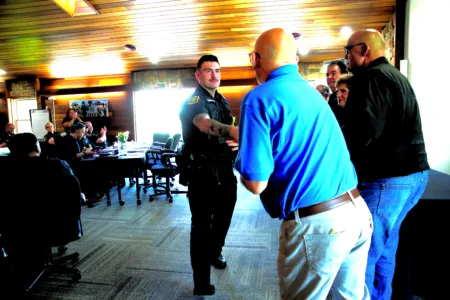
Greguolo was among 18 officers from agencies across Mahoning County who graduated from the county's Mental Health and Recovery Board's Crisis Intervention Team training program Friday. Dignitaries from the board, county and local police departments gathered at the Clarence R. Smith First Responder Wellness Center in Boardman for a celebratory luncheon.
The graduates were officer Jason Nespeca of the Adult Parole Authority; Boardman Police officers Greguolo, Zachary Ganser and Joseph Nenadich; Mahoning County Sheriff's Office deputies Rebecca Bailing, Michael Miller and Jaimasena Soos; Youngstown Police officers Dominic Andreozzi, Noah Baker, Efrain Andino-Cruz, Hunter Davies, Kristen Gill, Justin Hamilton, Jacolby Jeffries, Grace Ogden and Kody Smith; and Youngstown State University police officer Brandon Scott.
When police encounter someone in a mental health crisis, the difference between recognizing that crisis and treating it as common criminal behavior can determine if that person ends up in treatment or in jail.
MHRB runs an intensive 40-hour, weeklong program, in partnership with local agencies such as NAMI Mahoning Valley. The program is designed to provide police, first responders and behavioral health professionals with techniques and strategies for deescalation and safe management of calls involving mental health crises, substance use and high-stress domestic situations.
Youngstown Police Lt. Jerry Fulmer said CIT came to Ohio in 2000, and Mahoning County was an early adopter, beginning its classes in 2006. He said the county has graduated two classes per year since then.
Fulmer said CIT allows what had been separate systems to work together to better serve residents in turmoil.
"Basically, this is a collaboration between mental health and law enforcement, and it really brought us together so that instead of being two separate entities, we could actually work together and just give people the type of care that they need in collaboration."
Fulmer said he could not provide exact statistics on the spot but described the evidence as positive, mostly because police now know much more about what mental health agencies can provide, and those agencies better understand what law enforcement can do.
"Now we can actually give people the help that they need, as opposed to arresting them for minor crimes and then basically using the jail as a holding facility when really they didn't need incarceration; they needed treatment," Fulmer said.
Fulmer said that when Mahoning County started the training, the goal was to have 25% of all officers on the road at any time trained in CIT. He said that since 2006, 100% of police agencies in the county have CIT-trained officers, and usually at least one on the road at all times.
Fulmer said recidivism rates in the county have gone down, if only because fewer residents enter the justice system because police can more easily recognize that mental health resources, not prosecution, are the answer to that person's problem.
Fulmer said the remaining challenge is making sure officers know what resources exist and how to access them.
"The county has come a long way because programs law enforcement previously didn't know existed are now communicating directly with police and providing information officers can use to connect people with services appropriate to their situations," he said.
Jason Nespeca of the Adult Parole Authority has spent 23 years in probation and parole. He said watching officers go through the training was inspiring because their everyday interactions aren't the dramatic things people see on television, but constant contacts with people in the community.
"We're here to protect our society, but to serve means that we're going to impact somebody that is at their wit's end, it's at their worst moments, and we're going to be the ones that stand in the gap and make that difference," he said.
Mahoning County officials have spent much of the past year examining what they describe as a longstanding problem: the county jail has become the community's de facto mental health hospital.
Sheriff Jerry Greene said in March that 127 inmates at the jail were taking some form of psychotropic medication. Although most could appropriately remain incarcerated while receiving treatment, a smaller group of severely mentally ill inmates had "absolutely no business being in jail" but remained there because there was nowhere else to send them, Greene said.
He said those five, 10 or 15 particularly difficult cases can consume enormous amounts of staff time. Even when the jail secures a psychiatric hospital bed, he said, some inmates have been returned because their behavior was more than the hospital could manage.
Chief Deputy William Cappabianca said the jail provides mental health services to nearly 6,300 inmates annually. The jail employed three full-time master's-level licensed counselors, a psychiatrist, a psychiatric nurse practitioner and 19 nurses trained to recognize and screen for behavioral health problems. The county was spending about $642,600 annually providing those services.
In August, commissioners approved $60,000 in opioid-settlement money toward hiring a forensic mental-health navigator stationed at the Mahoning County Justice Center. The navigator is intended to serve as a liaison among inmates, the jail and courts, help move high-needs people to regional psychiatric hospitals and connect inmates with outside resources.
And while lower jail numbers and smaller budget lines are something everyone can appreciate, Boardman police Chief Todd Werth said CIT training really comes down to healthier interactions between police and the public.
"It is a great opportunity for our officers to gain valuable skills to better interact with individuals experiencing a mental health crisis," he said. "The work the Mahoning County Mental health Board does providing this training ultimately improves the safety of those officers and the people they are working to help."