

Laundry services navigate age of convenience
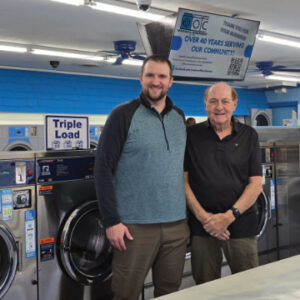
Father and son duo John and Brandon Baker standing proud outside their family business, Wash Well. Correspondent photo / Chris McBride
WARREN — Laundromat operators in the Mahoning Valley are navigating a market shaped by rising renter demand and a push toward modern convenience with businesses adapting to an era where time-strapped customers are looking for efficiency mixed with comfort.
Trumbull County’s rental market has tightened further, with Realtor.com recording a 5.88% increase in median rents as of October 2025. Nationally, the U.S. laundromat sector reached about $7.1 billion in revenue last year and is projected to hold steady or grow modestly in 2026, according to IBISWorld and Coin Laundry Association data. Nearly one-third of local households rent, a demographic the Coin Laundry Association calls the core driver of industry volume.
Marie Albrecht and her husband, Thane, run a multilocation operation that spans Mahoning County and traces its roots three generations. Marie’s grandfather started with an unattended laundromat in a former gas station on Belmont Avenue, later adding dry cleaning.
Marie Albrecht described how the family expanded in the 1980s and 1990s, opening attended stores and maintaining wash-and-fold services from the beginning.
They recently installed a garment-refresh machine at two locations that cleans, presses and sanitizes shirts or pants in four minutes while the customer waits. Thane Albrecht, who left carpentry to join the business full time in 2009, said the equipment targets travelers, busy professionals and anyone needing quick turnaround.
“We’re going to be the only ones around this area,” he said. “The next closest one I’ve seen is in Cincinnati.”
The Albrechts keep all their laundromats attended, with staff on site, free Wi-Fi, vending and games that they said draws customers from out of town specifically for their stores.
They continue home-delivery wash-and-fold on scheduled routes, serving nursing homes and older residents who prefer not to leave their apartments.
The family also said they’ve upgraded lighting to LED, installed an ozone sanitizer at one site and refreshed equipment at their Belmont location two years ago, adding machines from 20-pound to 100-pound capacity.
At their single-location Wash Well Laundromat on North River Road, John Baker, 79, and his son Brandon have focused on equipment upgrades and digital tools since Brandon returned to the family business several years ago.
John Baker bought his first laundromat in 1983 during lunch breaks from Packard Electric, later building the current store in 1990 after a rent dispute. Over the decades, he replaced top-loaders with front-loaders and steadily increased machine sizes.
In the past three years, the Bakers added washers up to 120 pounds and dryers with reversing tumblers and high-speed spin cycles that cut drying time.
“The trend has gone from a whole bunch of little washers to big washers,” John Baker said.
Brandon Baker installed the PayRange app for phone-based payments, rewards and promotions, avoiding the cost of card readers on every machine. They also revived pickup and delivery through the CleanCloud app, offering same-day service in some cases.
“We’re the only laundromat in the area that offers a digital experience through an app like that,” Brandon Baker said.
The Bakers keep the store brightly lit in calming blue tones, maintain high cleanliness standards and are on site daily. John Baker noted that many longtime customers still prefer smaller top-loaders, while younger users appreciate not handling quarters.
Several owners who spoke on condition of anonymity expressed more tempered views about the direction of the business. Some said rising utility rates have offset much of the expected energy savings from high-efficiency equipment. Some worry that heavy promotion of app payments risks phasing out older clientele or those who rely on cash and do not carry smartphones.
Both the Albrecht and Baker families pointed to family involvement and hands-on management as advantages in a changing market. John Baker recalled his immigrant grandfather’s coal and woodworking businesses and his own path from Canada to Purdue to Packard before buying the laundromat. Brandon Baker left a corporate banking job in Columbus and Kansas City to return and help sustain the operation.
Marie Albrecht said succession remains an open question for her family, with no immediate next generation interested in taking over.
Thane Albrecht learned the business on the fly after his father-in-law’s illness and now handles dry cleaning while Marie manages shifts and operations.
Industry observers note that successful operators in 2026 are focusing on speed, cleanliness, digital convenience and additional services such as delivery and quick-refresh options. Mobile payments are becoming standard in new or upgraded stores, and predictive maintenance tools are appearing on higher-end equipment. At the same time, many stores continue to rely on coin operation because it serves customers who cannot or prefer not to use cards.
Demand tied to renters is expected to remain steady in the Mahoning Valley and across much of the country. How individual businesses fare will depend on their ability to balance modernization with the practical realities of their existing customer base and physical footprint.
For some, the investments are paying off in faster turnover and broader appeal. For others, the risks of change feel greater than the rewards of staying the course.
Almanac 2026

‘Couples Therapy’ finds success on the road
In agriculture, ‘Bee’ is the buzz word
When it comes to articulating what he sees as the pivotal importance of honeybees and other pollinating insects’ ...
Weather delivers snow job late in the year
While 2025 was considered an average weather year for northeast Ohio, the most notable weather conditions of the ...

Eastwood Mall Complex attracts all types of fans
‘It is still a great time to be buying properties’
2025 was a strong year for the housing market as numbers grew across all facets. According to statewide housing ...