
Infectious disease specialist addresses pandemic readiness
Trending
YOUNGSTOWN – A comparison between how two major health crises more than 100 years apart should be handled, along with resistance to following such protocols, shows remarkable similarities, a healthcare specialist says.
“Max Starkloff, a physician and health commissioner, wrote an editorial in the St. Louis Post Dispatch about the importance of avoiding crowds,” Dr. Virginia “Dee” Banks, an infectious disease specialist and expert, said. “When a flu outbreak at a nearby military barracks spread into the St. Louis civilian population, there was no time wasted in closing schools and pool halls and all public gatherings. There was pushback from business owners, but Max Starkloff and the mayor held their ground. Thousands were treated at home by a network of volunteer nurses. St. Louis public health officials were able to flatten the curve and keep the flu epidemic from spreading.”
Banks was referring to the 1918 Spanish flu, for which the first known case was in Kansas before the flu quickly spread around the world. That pandemic was made worse during World War I when many soldiers were in close proximity to one another, Banks told a crowd of several dozen Youngstown State University students and others who attended a History in the Headlines lecture Tuesday evening at the Youngstown Historical Center of Industry & Labor, 151 W. Wood St., downtown.
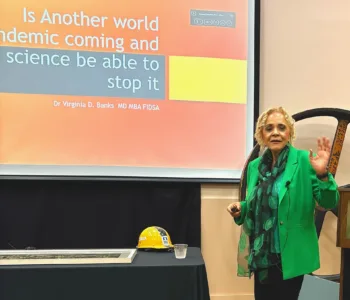
Banks’ presentation, “Is another world pandemic coming and will science be able to stop it?” was the sixth of eight such gatherings intended to cover topics YSU students selected earlier this year that are important to them. The goal is to demonstrate how the issues affect the local community, provide YSU faculty opportunities to share their knowledge and expertise, and give people a chance to discuss their opinions and thoughts with one another in a respectful manner.
Banks’ assessment of how health experts sought to deal with the 1918 health crisis in many ways mirrored the protocols for the COVID-19 pandemic that spread in early 2020.
Roughly one-third of the world’s population was afflicted, and as many as 50 million people are thought to have died from the Spanish flu, including 25 million deaths in the first 25 weeks of the outbreak, Banks noted.
She also discussed the HIV/AIDS epidemic that was initially recognized in June 1981 before being isolated two years later, with a combination antiretroviral therapy that revolutionized treatment by the mid-1990s. Nevertheless, an estimated 44.2 million deaths have resulted from HIV/AIDS since the early 1980s, and as of last year, approximately 41 million worldwide live with HIV, she noted.
Certain social factors contributed to the number of COVID-19-related deaths since early 2020, such as poverty, which “became a major predictor of COVID-19 deaths, especially in 2020, before the vaccines became widely available,” Banks said, adding that even when the treatments came out, many low-income neighborhoods lacked vital infrastructure that included pharmacies and hospital systems to deliver adult immunizations.
Further exacerbating the problem was the fact that many young adults with low income who worked in family-oriented businesses often took the virus home to multigenerational relatives in their 40s through 80s who became infected and died, she explained.
During her nonpartisan lecture, Banks also cited the findings of Dr. Peter J. Hotez, a renowned scientist, physician, pediatrician and advocate in the fields of tropical disease control, vaccinology and global health.
While not expressing overt criticism regarding certain responses to the COVID-19 crisis, Banks opined that schools may have been closed too long, citing data that shows some children still lag behind academically and socially from being removed from the classroom. She also said that little scientific evidence backed up claims that people needed to social distance via being at least 6 feet from one another.
“We didn’t get that right,” she said about the length of the school closings.
ARE WE READY?
Since the COVID-19 outbreak began in March 2020 in the U.S., much scientific knowledge, progress and emergency response experience has been gleaned, although today, preparedness remains uneven across countries and institutions, Banks cautioned. She added that as of last month, “international assessments still identify significant gaps.”
Improvements between six years ago and today include genetic sequencing technologies that can identify new pathogens, research platforms capable of accelerating development of new vaccines when a new virus is identified, and more experience with outbreak surveillance, emergency coordination and infection control. In addition, the World Health Organization adopted a pandemic agreement in May 2025 to strengthen international cooperation, Banks said.
Nevertheless, challenges remain.
Public health funds and trained personnel may not be enough if an outbreak grows quickly; countries differ in their ability to detect infections, conduct lab testing and deliver medical care; access to vaccines and medicines might be unequal, especially early in a crisis; and political disagreements, misinformation and an erosion in public trust can delay a timely and effective response, she warned.
Banks also gave an assessment of whether the U.S. will be able to manage another health crisis, saying that even this nation’s research institutions, advanced labs, vaccine development capabilities and extensive healthcare system “do not guarantee that the country could manage another pandemic effectively.”
In her talk, she pointed to a U.S. Government Accountability Office report earlier this year that showed the U.S. Department of Health and Human Services “was not collecting and analyzing enough information about how well jurisdictions could meet established public health and healthcare preparedness capabilities.”
Other factors that have had a serious negative effect on preparedness were funding and staff cuts as well as administrative leave orders from the President Donald Trump administration to USAID, which President John F. Kennedy established in November 1961. Many low- and middle-income countries had relied on American assistance to strengthen their public health systems, Banks noted. A frightening consequence of the Trump administration’s decision is that “countries may be less able to detect infectious diseases early, contain outbreaks quickly and prevent them from spreading across borders,” she said.
Other problems the budget decision could create include weaker disease surveillance and slower detection in those countries, reduced lab and testing capabilities, loss of trained response teams and other vital personnel, a greater strain on routine healthcare and vaccination treatments, and weaker international cooperation, Banks told her audience.
In the next few years, global aid cuts may result in at least 9.4 million additional deaths by 2030, with an estimated 2.5 million of them in children 5 and under, according to a new study in the Lancet medical journal Banks cited.
The next global threat could be a new influenza strain capable of spreading between humans, combined with limited existing immunity, a new coronavirus variant or other respiratory virus, a virus that could spread through the air before people know they’re infected, a disease that is transmitted from an animal to a person or a pathogen that crosses from wildlife or domestic animals to humans, she explained.
“Surveillance at the intersection of human, animal and environmental health helps identify these threats,” Banks added.
In the short term, however, global health data and models predict that the likelihood of a new major pandemic this year is about 4%, she noted.
LESSONS FROM COVID-19
It’s imperative that access to primary care is increased and overall healthcare capacity, including hospitals in rural, underserved areas, is improved. Also, a robust public health workforce able to handle health threats as they emerge instead of being mainly reactive is needed, she noted.
“Our experience with COVID was a real-time lesson in health equity,” Banks said. “We learned about the importance of addressing social needs and how that impacts people’s vulnerability to COVID-19 and their ability to manage resources. Socioeconomic status, race, the opportunity to work from home, household density, community density, health literacy, access to information and to vaccines – all those factors informed disease patterns.”
Banks concluded her presentation by saying she feels that if we see another pandemic, health experts and others need to abandon a paternalistic approach and meet people where they are. It also would be critical to demand greater transparency and clearer communication from the Ohio Department of Health in Columbus, along with other state leaders, she added.