
YSU senior details atrocities of Islamic Republic
Trending
YOUNGSTOWN -- Negin Mirzade bitterly recalled the day police arrested her at age 14 while she waited for her sister to pick her up from a class.
Mirzade’s “offense?” Wearing a light-blue pair of shoes the police claimed would attract male attention to her.
“The police called me names, like ‘prostitute” and 'a shame to my family,'" Mirzade, 25, a Youngstown State University senior and chemical engineering major, said.
Mirzade, who came to the U.S. in January 2022 from her native Yazd, Iran, shared her experiences -- as well as a series of atrocities the Islamic Republic has committed in the past 47 years -- in a lecture she gave Tuesday evening at the Youngstown Historical Center of Industry & Labor, 151 W. Wood St., downtown.
Hers was the third presentation of a History in the Headlines series based on issues YSU students had selected. The goals are to show how such topics can affect the Mahoning Valley, allow YSU faculty and students to share their insights, and provide a space for people to respectfully discuss their views, opinions and perspectives, organizers said.
Mirzade used most of her talk to offer an imprimatur outlining the atrocities against Iranian citizens to bolster her argument on why she and many others feel that the Islamic Republic should never be able to get its hands on a nuclear weapon.
The police detained the 14-year-old Mirzade and kept her in a van for about a half hour, during which time they threatened to have her expelled from school, she recalled.
“I was traumatized for a couple of years,” Mirzade told an audience of several dozen YSU faculty, students and others.
She wasn’t the only one in the family, however, who had such frightening encounters with authority figures. The Islamic Republic’s Military of Intelligence summoned her mother three times merely for her views about science, Mirzade said.
SERIES OF ATROCITIES
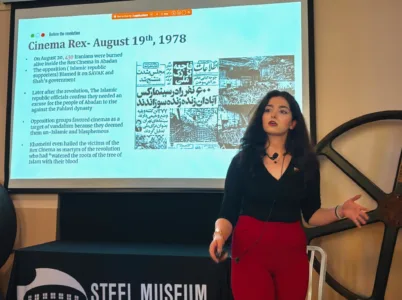
Mirzade, who also recently completed a summer internship as a lab technician in Mercer, Pa., detailed the Aug. 20, 1978, massacre in which 430 Iranians were burned to death inside a movie theater in Abadan, Iran, before the Islamic Republic blamed the killings on the Shah of Iran’s government.
“Opposition groups favored cinemas as a target of vandalism because they deemed them un-Islamic and blasphemous,” she said.
In another act, prostitutes were burned alive after being trapped in buildings, Mirzade continued.
On Feb. 12, 1979, the Islamic Republic Court began executing people mere days after winning the revolution. Specifically, Sadegh Khalkhali, who headed the court, killed more than 1,400 generals as well as those related to the Pahlavi dynasty, she noted.
“Khalkhali did not care if someone was proven to be innocent,” Mirzade said, adding, “He shot Abbas Hoveyda, the prime minister of the Pahlavi dynasty that was proven to be innocent while he was waiting for his last court visit.”
Soon after the revolution, many women began a two-year protest against wearing the mandatory hijab before which universities and branches of government were shut down to prevent people from protesting against that rule, she noted.
Mirzade also provided details about the Iran hostage crisis that started Nov. 4, 1979, when 66 American diplomats and others were held against their will at the U.S. embassy in Tehran. Of the 66, 52 of them were held until January 1981.
Many executions occurred in 1988, including one in which an estimated 30,000 political prisoners were killed, many of whom had assisted the Islamic revolution, Mirzade said. She added that Ayatollah Ruholla Khomeini ordered the executions that took place over a five-month period in at least 32 Iranian cities.
Simultaneously, many women were sexually assaulted, executed and buried in mass graves. To this day, no information is available regarding the location of the burial sites, she said.
From 1988 to 1998, Iran had a series of “chain murders” and disappearances of especially dissident intellectuals such as writers, poets, translators and political activists, as well as ordinary citizens, who were critical of the Islamic Republic.
On July 8, 1999, nonviolent student protests got underway in Tehran after the closure of Salam, the reformist newspaper. Consequently, the Islamic Republic arrested between 1,200 and 1,400 students, Mirzade said. She added that more than 79 of them disappeared, including Saeed Zeinali, whose family continues to search for him.
Also discussed was the Green Movement that arose after the June 12, 2009, presidential election, and it continued into early 2010 as protesters demanded that Mahmoud Almadinejad be removed from office. An estimated 78 protesters were killed in the streets, and hundreds of arrests occurred as the demonstrations became more violent in the ensuing months, she noted, adding that many detainees also were brutally raped.
In late 2014, a series of at least 25 acid attacks against women in Isfahan, Iran, took place, leading to widespread fears that they were targeted because they were not “properly veiled,” Mirzade said, adding that the Islamic court dismissed all of the cases.
A 50% to 200% rise in fuel costs led to protests in 2019 and 2020 that began peacefully Nov. 15, 2019, then spread to 21 cities. Nevertheless, the government shut down the internet throughout the country for nearly a week to block information sharing about the deaths of hundreds of protesters. In all, at least 2,000 Iranians were killed over two nights, she noted.
In addition, between 300,000 and 700,000 citizens died during the COVID-19 pandemic after Islamic Republic officials banned and refused to import vaccines from the U.S., Mirzade said, adding that the government confirmed more than 8 million cases.
“For the first few months, they refused to say COVID was in the country,” Mirzade said.
In September 2022, a 22-year-old Kurdish-Iranian named Mahsa Amini died in a hospital in Tehran under suspicious circumstances after police had arrested her for not wearing a hijab. That led to protests that developed at the hospital and spread to other parts of the country. At least 551 people, including 68 minors, died and more than 19,600 arrests were made, Mirzade continued.
Also, Mirzade’s mother was poisoned while she was teaching, as part of a series of chemical attacks in November 2022 across at least 100 schools, the YSU senior recalled. The poisonings were to prevent students from rising against the regime, she explained.
“Regime officials later confessed these attacks were carried out in avenging the ‘Woman, life, freedom’ movement,” Mirzade added.
Additional protests germinated in December 2025 after markets crashed and many people lost their money because of a 300% inflation rate, she noted. Once again, government officials shut down the internet, phones and landlines “to prevent any connection to the outside world,” she said.
Mirzade also discussed the Feb. 28 attack on the Shajarah Teyyabeh Elementary School in Minab, Iran, at the start of the U.S. war with the country in which an estimated 168 schoolchildren were killed, according to Iranian officials. The United Nations education agency, UNESCO, has called the bombing, “a grave violation of humanitarian law.”
Nevertheless, Mirzade referred Tuesday to the war as “a rescue mission for the Iranian people,” saying that, for decades, the Islamic Republic has been calling for death against Americans.
While conceding that the bombings have killed some innocent people, about 99% of the strikes have hit military bases, personnel and other attachments to the Islamic Republic, she said.
The war is necessary to “take out” regime leaders to ensure the Islamic Republic does not become stronger and possibly obtain nuclear capabilities, Mirzade added.