
Professor: History behind current events promotes understanding
Trending
YOUNGSTOWN -- A Youngstown State University Russian history professor said learning the history behind current events, such as the Russo-Ukrainian War, helps people understand those events by contextualizing them and providing insight into what led up to them.
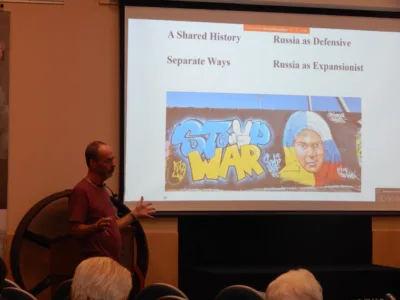
Brian Bonhomme gave a presentation on Ukrainian and Russian history Tuesday as part of YSU's History in the Headlines series at the Youngstown Historical Center of Industry and Labor, also known as the Youngstown Steel Museum. The series features speakers discussing how history affects current events and how those events can affect the Mahoning Valley.
"I think that, not just in this area, but generally speaking, understanding the history of something from the beginning gives you insight into what's going on now that you can't get by just looking at what's going on now," Bonhomme said.
"I think to really understand any conflict, or any modern situation, it's really important to understand at least an outline, like where it came from, how it was built bit by bit. These things don't just suddenly emerge out of nothing. There's always context, preconditions and things like that."
Bonhomme compared the relationship between countries, like Ukraine and Russia, to relationships between people, saying that added background and context is needed to truly understand the nuances.
"You can think about it in terms of a personal relationship. If you've had a relationship with a sibling, parent or significant other your whole life, that relationship is not something that just renews itself every day," Bonhomme said. "It's the result of everything that you've been through, through the whole of your lives."
Bonhomme said he does not believe a negotiated peace between Russia and Ukraine is feasible because of longstanding animosity between the two, which was exacerbated by Russia's 2022 invasion of Ukraine.
Bonhomme then explained that learning history is not just for academics, but also can help the general public with how they consume information about current events. He also criticized the way information these days is presented, arguing that it's led to people having shorter attention spans.
"We have a news cycle that's very present oriented, and very short term. Some things in the news that you've never heard before are all over the news, and a week later it's disappeared and you never see it again. We have social media, artificial intelligence and a culture that really likes little bits of information for a short period of time," Bonhomme said.
"I think far too much of the information people get about current events is just a little factoid, or something that lasts for a minute. You know, a headline, a short article and then you move on to something else. That's a lot of stuff you get on the internet ... I think it's important to actually dig into an issue and understand it."
For Bonhomme, that makes teaching history more important because it presents the real complexity of issues.
"I think it's important to counter that with actually considering at length the complexity of topics," Bonhomme said. "I think the study of history, the study of any of the main academic disciplines, is more important these days than ever before, in large part because all of the modern technologies are helping us kind of lose our attention span."
The next History in the Headlines topic is economic inequality with YSU economics professor A.J. Sumell. It is Oct. 20 at the Center of Industry and Labor.