
Photographer chronicles NFL’s 49ers in Butler exhibition
Trending
Michael Zagaris played football and baseball growing up as a teenager in California and later at George Washington University.
He relied on that experience when he went from playing those sports to photographing them, but it wasn't the technical knowledge -- anticipating what might happen on the field and knowing the best place to stand to capture it -- that shaped his work.
"I was shooting action, but I was also doing a lot of stuff on the bench, because I wanted to get up close and personal," Zagaris said. "I wanted the pictures to convey the feelings I had when I played about what it’s like to be a player -- somebody coming out, sitting on the bench, sweating, in contemplation."
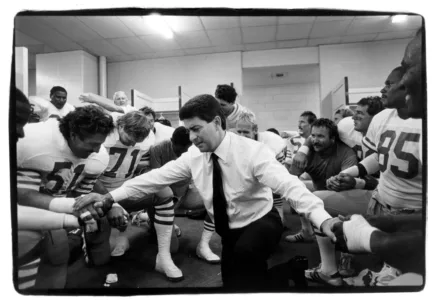
Now in his 54th year as team photographer for the San Francisco 49ers, Zagaris captured the on-the-field achievements of a team that won five Super Bowl trophies in eight appearances as well as the quieter moments on the sidelines and in the locker room that didn't make the highlight reels on "SportsCenter."
"Michael Zagaris: 60 Years of NFL Photography," which opens Nov. 1 at the Butler Institute of American Art, chronicles that aspect of Zagaris's colorful, multi-faceted life.
Witness to an assassination
Zagaris, 81, liked photography enough that, as a teenager, he figured out how to duplicate a 49ers photo credential to get on the sidelines and closer to the action, but he never considered it a career. He described himself as an idealistic young man who had his life planned out -- a major in politics in college, hopefully a professional football career, followed by runs for the House of Representatives, the Senate and ultimately President.
He was on that path, at least the political part of it. He worked as a page for Pierre Salinger, former press secretary for President John F. Kennedy, when he was appointed to the U.S. Senate representing California following the death of Clair Engle. He later worked for Robert Kennedy when he was a New York Senator.
Zagaris returned to California after graduation and enrolled in law school at Santa Clara University.
"I knew a month into law school, it wasn’t what I thought it was going to be like," he said. "I thought, I’ll finish the year, and then I’ll see where I am from there."
When Kennedy announced he was running for President in early 1968, Zagaris worked on the campaign while still pursuing a law degree. He was in Los Angeles on June 5, 1968, for Kennedy's speech at the Ambassador hotel.
Zagaris was trailing behind the senator shortly after midnight as he was led through the hotel's kitchen.
"I'm shuffling along, and as we get to the kitchen, it sounded like somebody let off a string of firecrackers," he said. "I slipped and almost fell. I'm thinking it's oil; it's blood (from) Paul Schrade, the union man that was behind Bobby who had been shot ... I still don't know what's going on. You can hear yelling and screaming. I remember hearing Ethel's voice (Kennedy's wife) and I realize somebody's been shot and that it was the senator."
The next morning, Zagaris had to fly back to San Francisco for a contract law final exam, and he heard that Kennedy died after his plane landed. Still numb from the events just hours before, he sat in the classroom and looked at the single-spaced list of questions and the stack of blue books where he was supposed to write his answers.
"I filled eight blue books with how America was f--– and murdered its leaders," Zagaris said. "That was the end of law school."
From aspiring politician to rock photographer
Within two weeks, Zagaris began experimenting with acid after reading Aldous Huxley's "The Doors of Perception." He also started hanging out at The Fillmore, a legendary San Francisco concert venue owned by promoter Bill Graham.
"I’d always been deeply immersed in music in my life, and the bands that were coming through that were really resonating -- not just with me, with most people -- they were the English bands that were using a lot of our American blues roots that a lot of kids had never heard before," he said. "They also brought their own style and showmanship, and they were both changing our culture and being changed by it."
He brought his camera to shows, but Zagaris also chronicled the counterculture, photographing such people as Bobby Seale of the Black Panthers and Harry Edwards, who organized the Olympic Project for Civil Rights, which led to the protests during the 1968 Summer Olympics in Mexico City. It wouldn't be his last time documenting civil rights activism.
The images that will be shown at the Butler and the ones that fill his website (zmanphotography.com) show incredible technical skill, but Zagaris isn't someone who rattles off aperture settings and film speeds in discussing his work. He captured his unguarded, behind-the-scenes moments by embedding himself with many of the artists he photographed in the same way a war photographer might embed himself with an army unit.
"Much like an actor that’s using the Stanislavsky method, where you become what you are, I wanted to do that (with musical acts), and camera was going to be my entry into that world," Zagaris said. "I would use it as a mirror to document what it’s like if you are in the band. That was the next best thing to being in the band. The only people that were in those intimate settings were the bands, the road manager, a couple of the roadies, maybe a girlfriend or two, and the dope dealers. I wanted that experience."
He shot album covers for Peter Frampton, Doobie Brothers, Nicollete Larson and others. He photographed Led Zeppelin's final U.S. concert and the finale of the Sex Pistols only U.S. tour, which ended with the band breaking up in San Francisco. He captured candid images of classic rock icons such as The Rolling Stones, The Who and Eric Clapton as well as revolutionary artists that followed, including Lou Reed, Patti Smith and The Clash.
"I never made any money to speak of doing that. But I’m traveling all over, mainly with English bands. You got free travel. You’re with your guys, and at this point in time, we were all pretty much the same age. Beautiful women, free drugs -- all the things that, if you had money, you would have spent it on. And I thought it was one of the great times in my life."
Back to the gridiron
While still doing music, Zagaris realized he missed photographing sports. He reached out to the public relations director for the 49ers and was told they only give passes to accredited members of the media. Zagaris flipped through the sports publications he regularly read, found the name of the editor of Football Digest, and called again, this time claiming to be that magazine's editor and asking for access for one of their photographers -- Michael Zagaris.
That led to Zagaris shooting the 49ers' games starting in 1973, and he saw an opportunity to do more when Bill Walsh was hired as head coach in 1979 by the team's owner, Youngstown native Edward J. DeBartolo Jr.
"I didn't know Bill, but I knew about him, and I knew he was very cerebral," Zagaris said. "I got a meeting with him and we hit it off right away. I said, 'Coach, I think you're going to do really great things with this organization. I want to document it, not like a sports photographer. I want to shoot this and cover it much like a Presidential photographer covers the White House, which means I have total access, and by that I mean I want to be in the locker room pregame, halftime, post game. I want to be on the bus, on the plane, on the field. I want to cover it totally, not just for the team, but for the league and for the fans. I want to show it in a way that’s never been shown before, more from the point of view of players and coaches. And I want to be able to take people where they have never been and illuminate what the NFL experience is like.'
"Walsh listened, and he got it."
Since then, Zagaris has been in right place to capture the Hall of Fame worthy plays of Joe Montana, Jerry Rice, Ronnie Lott and others on the field as well as Montana sitting on the locker room floor at Joe Robbie Stadium at Super Bowl XXIII or a shirtless Eric Wright lying on top of equipment bins in the locker room at halftime.
He also documented the controversy that surrounded quarterback Colin Kaepernick kneeling during the National Anthem in 2016 as a protest against systematic racism and police brutality. The crowd reaction at some stadiums was so intense, Zagaris said he felt as if he was getting a glimpse of what it must have been like for Jackie Robinson in 1947 when he integrated Major League Baseball.
"I thought, 'This is history. This transcends sports, and I want to cover this.'" Zagaris took the photo of Kaepernick used on the cover of Time magazine.
Zagaris said the opportunities provided by the 49ers are among the many serendipitous moments in his career that also included work for the Oakland Athletics baseball team and Oakland Raiders football team.
"I was very fortunate that I was where I was, and that he (Walsh) was the person they brought in as head coach," Zagaris said. "I’ve been with an organization, the 49ers, first with the DeBartolo family and then with the (Denise DeBartolo) York family, that’s allowed me the freedom of expression to document this.
"I don’t believe in coincidences. I believe everything happens the way it’s supposed to. I’ve been incredibly lucky to have all these things and all these people intersect in my life."