
Kids’ art, poetry emphasize Nonviolence Week in Ohio
Trending
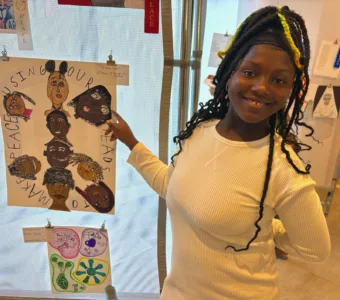
YOUNGSTOWN – Tyleena Harris expressed considerable pride and joy to have helped create a piece of peace.
Others who view her artwork may readily conclude that she really used her head.
“I found it was a cool design. I always like to draw and color,” Tyleena, a St. Joseph the Provider school fourth grade student, said.
Specifically, hers was one of nine faces drawn on the artwork, titled “Using Your Heads to Make Peace,” to which several of her peers also contributed their artistic flair.
In addition, the entry was among those that area middle and high school students submitted, then were shown and celebrated during an art and poetry reception Wednesday afternoon at the main branch of the Public Library of Youngstown and Mahoning County on Wick Avenue, downtown.
The one-hour program that the Mahoning Valley Sojourn to the Past organization hosted was part of Nonviolence Week in Ohio, which continues through Saturday.
Artwork, though, means more than her peers merely creating something for its own sake, Tyleena said.
“They can do anything they want in the world and not give up, and create what they want,” she observed.
The theme of nonviolence also spread across a painting Aubrey Schooley made – and for which the Holy Family Elementary School fourth grader earned a second-place ribbon. Her work, titled “Peace is Joy,” shows a serene setting consisting of a series of nearly alternating colorful hearts and peace signs, accented with flowers and two smiling girls in the grass.
Taking home ribbons for art projects is nothing new for Aubrey, however. In April, she won first place for a poster she made, “Turn Around, Don’t Drown,” for an Ohio severe weather contest in Columbus.
The event’s keynote presenter was Shaunda Yancey, an English teacher at the new Youngstown Middle School, who impressed upon the young students how she strongly feels the arts can transform lives, be a tool for activism and create a far healthier cycle for young people than violence.
“Violence has had the microphone for too long,” Yancey said, adding that it’s vitally important for others to not only admire the students’ art pieces, but to engage in conversation with them about the details of their works.
The arts, whether it’s poetry, writing, painting, dancing, drawing, singing or other forms of creativity, has a way of aiding in self-healing, dealing with individual and collective grief and giving the young artists a positive channel and language with which to express themselves, she noted.
“I believe something very strongly: Young people need the arts,” Yancey said, adding that the climate of violence, racism and other societal ills further underscores that sentiment.
An emotional Yancey also lamented the recent spate of violence in the city during the past weekend, including the killing of Bruce Clinkscale, 20, who was shot to death early Sunday morning near East Lucius and South avenues on the South Side. Later that day, a woman who has not been identified was fatally shot on Cooper Street, also on the South Side.
“Those were two human beings, two families, two groups of friends, two futures,” a tearful Yancey said, adding that such acts always create ripples that permeate and damage families and communities.
She also encouraged young people to write about an array of topics such as what they see and hope for and what hurts them, as well as their feelings about those lost to violence and others who have been victims.
“It’s good to get them young,” Liz Kovalik, a St. Joseph the Provider school art teacher for students in kindergarten through grade four, said.
Kovalik, who has taught the subject more than 30 years, added that she had her students create works that depicted peace and centered around the theme of nonviolence. Part of that also entails befriending and including others instead of excluding them, Kovalik said. The longtime teacher added that she gave the students their assignment on the first day of school.
Melissa Birmingham, a LIT Youngstown board member, said she judged more than 40 poems. The primary criteria upon which the entries were judged were originality and messaging, along with the students’ “creative spark” and their take on the concept of nonviolence, she noted.
Penny Wells, the Mahoning Valley Sojourn to the Past’s executive director, estimated that close to 50 poetry entries were received, the most since the event began. That was on top of several hundred art submissions from students throughout Mahoning County and western Pennsylvania, she added.
“You can be an activist through poetry writing and artwork,” Wells said, adding that Valley Christian School in Youngstown was among those for which this was the first art and poetry contest.