
Austintown introduces its Drone First Responder Unit
Trending
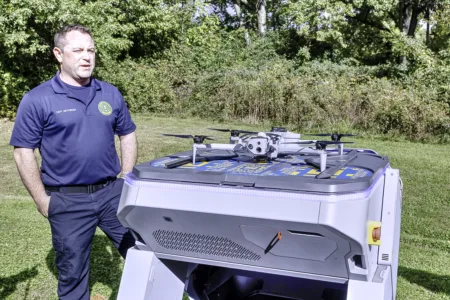
AUSTINTOWN – Showing how modern technology can aid first responders, the Austintown Fire Department held a drone demonstration Monday morning at its No. 1 station on Niles-Canfield Road.
“The big thing is it not only keeps our firefighters and police officers safe by having this technology, but also our residents with helping ensure they’re getting the right amount and type of help as fast as possible for them," said Austintown Fire Captain Tom Metzinger, who is also the lead on its Drone First Responder (DFR) Unit.
He continued, "The idea is simple. When a 911 call comes in, a drone can launch and be on the scene within minutes or even seconds, often before our crews arrive. It sends live video back to our responders. So, by the time they pull up, they already know what they’re walking into, where the fire is, whether someone’s in danger and what resources we actually need. It also gives our dispatchers context and a real-time view of what’s taking place."
Offering an example of its use, he said, "We had a fire a few months ago. The drone got there within about 90 seconds, which was a minute-and-a-half before the fire truck pulled up. So, they were able to see exactly what was going on before they got there.
"It helps us make better decisions. Normally, if you’re coming down the street, you see the building's on fire. You’re reading the fire, the smoke, and you have seconds to make a decision of how you’re going to handle it. With this, it’s buying our crews minutes to come up with a game plan to mitigate the situation."
Township officials and trustees, Austintown fire Chief Dave Schertzer and Chief Don Hutchison and Deputy Chief Mark Pitzer from the Cardinal Joint Fire District in Canfield, as well as Mahoning County EMA Director Conner O'Halloran, watched a drone housed next to the station take off and, via its camera, kept up with its journey flying above treetops and reaching its destination – a seven-floor apartment building on Westchester Drive. After circling it, the drone returned to its dock, which includes the landing pad, charging capabilities and the roof that opens and closes for the drone to fly in and out.
"We actually did have a fire there earlier in the year. The call came in as a fire alarm. A lot of times, those are false. The drone would have showed us, not necessarily that there was a fire, but that there was a person, in the middle of January, on a balcony and water pouring off of it, which is usually a good indication that there’s something on fire. It was the sprinkler system that was causing the water."
The drone pilot then switched on and lifted off the one located at the No. 3 South Raccoon Road station, flying it to survey vehicles on the side of the Ohio Turnpike and return. Its location allows the drone to get into Youngstown, parts of Boardman and a lot of Canfield.
Mike Maiorana, who piloted the drones on Monday, explained the process to become certified to fly them.
“We had to study for a test, the FAA Part 107 (for Remote Pilot Certificate), and prepared for it from April to June,” he said.
Overall, there are nine certified drone pilots on the Austintown Fire Department. Metzinger said they are on an on-call rotation and able to activate one from their homes.
Unfolded with propellers, the Skydio X10 drone measures 31.1"x25.6"x5.7", weighs nearly five pounds with batteries installed and can move up to 45 mph.
The department received the drone in early June and has used it on nearly 100 calls. Metzinger put together the grant shortly after the Phoenix House Apartments explosion and fire at 850 N. Meridian Road last November.
"It would have been extremely helpful getting us eyes on the building to truly see what was going on. I was going to the back hall that day and the picture that was painted to me from the callers was not exactly what happened," Metzinger said.
"This would have given me the real-time intelligence to call specific resources based off of what we were seeing and then also give us the ability to do a better faster scan with the thermal imagery to see if there are any victims anywhere."
Township Administrator Mark D'Apolito said, “We were able to obtain these through ODOT grants. So, they were fully funded by the Ohio Department of Transportation. We’ve got some small ancillary costs associated with them, but those costs are certainly minimal when compared to the advantage it provides to our public safety forces here in Austintown. We’re excited to have this technology, and it’s going to be really helpful."
He added, "It’s going to increase public safety and save some dollars along the way because we’re not sending unnecessary resources. Two things happen when you send unnecessary resources. You put people at risk because they’re rushing to a scene. You’re also spending financial resources that don’t need to be spent and we want to have the best possible outcomes for everyone that's not in a great situation needing assistance."
Because of the popularity of drones and their growing use as delivery systems by Amazon, the skies could be crowded.
“It’s a concern, definitely, but the system that’s set up is designed to avoid (another drone). Things can go wrong but if another drone comes up near me, that should automatically shift out of the way,” Maiorana said.
With all the recent controversy surrounding Flock cameras, Metzinger addressed privacy concerns
“There’s all types of encryption going into the software. Everybody has their own username to sign in. They have to do a six-digit PIN that gets sent to their email to be able to access it. All of the recorded data is ours. There’s only a handful of people in the department that have access to it. If we needed to distribute it somewhere, whether it’s the media or any of our mutual aid or police department, one of the four people who have access to it would be the one to do that. It doesn’t get shared anywhere else.”