
‘Men don’t normally do this’
Muscle soreness leads to rare case of breast cancer for North Lima man
Trending
Breast cancer doesn't discriminate -- men can get breast cancer too. Breast cancer awareness isn't just for women; awareness is for everyone. Awareness saves lives, and early detection can make all the difference. Know the signs, pay attention to changes.
John Pluchinsky, 62, of North Lima, grew up on Youngstown's South Side and has been active his entire life. He played baseball from age 10 to 22 and is an avid golfer. He is a national sales account manager for Boston Beer.
Pluchinsky discovered a lump in his breast in 2020 while at the gym.
"I was extremely sore one day after working out and just started stretching and pressing on my chest that day and found a tiny lump," Pluchinsky said.
He immediately called to make an appointment, but they couldn't get him in right away. The biopsy was done about two weeks before going on a golf outing with friends, but he did not get the call from the doctor that it was cancer until returning from the outing.
"While having the biopsy, the minute they told me it was vascular, I knew it was a tumor. My sister treated cancer patients. She was a radiation therapist, and I had a bad feeling from what she had told me. It was literally not even the size of a pea. I was extremely lucky," he said.
Pluchinsky's wife, Rossana, reached out to The Vindicator about her husband's cancer in the hope that his voice about the disease can help other men who face it and remind men that they can also get breast cancer and urged men to do breast self-exams.
"Women are constantly told to do breast self-exams, but men seem to be overlooked. It is a disease that affects men as well, and people need to know that," Rossana said.
Pluchinsky had already experienced cancer before finding the lump. He had melanoma several times in the past.
Although there is no known breast cancer in Pluchinsky's family, his mother was diagnosed with colon cancer at the age of 55. They believed she had been cured of the illness; however, it recurred four years later, spreading to her brain, lungs, and breast. He lost his mother at age 59.
After the diagnosis, he first went to Joanie Abdu Comprehensive Breast Care Center in Youngstown. The surgery to remove the tumor was performed at St. Elizabeth in Youngstown. The tumor was staged to be not even stage one. The surgeon at St. Elizabeth did not put him through chemo or radiation treatment before the surgery.
"At Joanie Abdu, everyone was a woman. They gave us a ton of literature, but all the literature was 'she,' 'her,' and 'woman,'" Rossana said.
All chemotherapy treatment was performed after surgery at the Hope Center in Howland. A Cleveland Clinic oncologist was always on call and worked with the Hope Center oncologist.
"They threw the book at me because of my family history," he said.
Pluchinsky underwent eight hours of chemo treatment every three weeks for a full year. There were six months of hard chemotherapy, and then they backed off and used other drugs for the last six months. He was very weak and lost 35-40 pounds during treatment.
"I tried to plant a tree during the time I was undergoing treatment. I was so weak, I had to call a neighbor to come help me walk back to the house," he said.
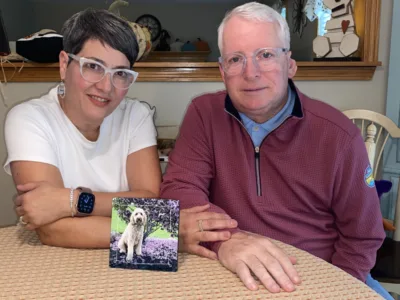
Their dog, Luna, was a comfort to Pluchinsky during the time he was undergoing chemotherapy and was feeling sick at home.
"She was a working breed but stayed by me. She knew something was up," Pluchinsky said.
Initially, only the affected left breast was removed in April 2020, but in November 2020, they decided to remove the right breast as well, just to ensure the estrogen-fed cancer did not return in the other breast. Pluchinsky is rechecked once a year for breast cancer.
Pluchinsky said he heals very quickly. Typically, a drainage port stays in for 7-10 days, but he only needed it for about three days.
"I will be on tamoxifen for ten years. Usually, you only take it for five years. My mom called it the devil drug. When I first took it, I wanted to rip my skin off," Pluchinsky said.
He now has arthritis in his hands and knees because of the drug and explained that very little research exists on its use in men.
Pluchinsky discussed the fact that his fair skin and blue eyes make him more prone to melanoma. Eighteen months after completing chemo treatments for breast cancer, a melanoma was found on his ear. University Hospital removed it in September of that year, but it recurred in February of the following year, when he required another surgery on his ear. They also removed lymph at that time from his chin and neck. He receives a retinal scan every six months and a CT scan every three months to ensure there is no recurrence of melanoma.
"We have one grown son and two grandsons. I have spoken to my son about doing breast self-exams. Men don't typically do this, and if he hadn't rubbed his chest the way he did that day, he might never have found it," Rossana said.