
Hubbard library offers Memory Care Kits
Trending
Hubbard -- When Hubbard Public Library Director Lorena Stearns learned of a senior citizen's issue with reading, she found a way to solve the problem.
This eventually led to the creation of a Memory Care section in the reference area at the library.
"One of our regular patrons came to me and said that her mother still liked to read, but she was having problems with comprehension and staying focused on long books," Stearns said.
She discovered books written by Emma Rose Sparrow that featured short paragraphs, few chapters, colorful photos and characters to which the mother could relate.
Offering the books brought up the realization that other patrons needed activity items for people with dementia.
"We also offer three of the Oui Si (we see) games to take out," Stearns said.
The games use photo cards to focus on matching or can be used as conversation starters.
"We work closely with Elmwood Senior Care Facility in Hubbard. They have a memory care community," Stearns said.
For her, this is a passion project as well as a way to help the community.
"My maternal grandmother passed away from Alzheimer's/dementia," she said.
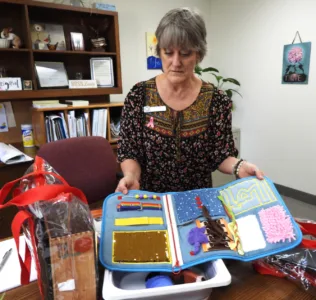
The library decided to create Memory Care kits that patrons can check out for two weeks. Each kit has an information binder and brain games that the borrower keeps. There are five types of kits, each with different activities, including a sock matching kit that includes socks and a collapsible basket. The socks are matched and tossed into the basket. Bombas donated the socks.
There is also a Bananagram kit with a flexible hands-on word tile game, which stimulates memory and a Boomer game kit with celebrity clues from the ’50s, '60s and '70s.
The creators of the Hubbard Public Library kits sought knowledge from experts.
"As many as our staff who were available attended a class with Barbara White, MLS, Dementia Friends Champion Coach and Co-Author of 'Dementia Inclusive Public Library Guide,'” Stearns said.
They also partnered with the Ohio Council for Cognitive and Mental Health and used guidelines from them. Both groups provided advice and training to help put the kits together.
"The people at the front desk are the first people to notice if a regular patron has not visited the library for a time or if they are acting differently,” she said.
Training staff in numerous areas of the library, especially the people who deal with the public, helps them spot potential early signs of dementia or Alzheimer's disease.
Stearns presented information on the library's Memory Care Collection at the 2026 Ohio Library Council Convention and Expo.
"A few of the other librarians talked to me after my presentation to share ideas and compare notes on their memory care efforts," she said.
The library director sees that her facility offering memory kits instead of a senior social service agency makes sense because it is part of the community.
"Libraries are approachable, and people come in for a lot of different things. People may not know where to go for a social service, but the library is nonthreatening. They may see something and ask the librarian about it. It opens up the opportunity," Stearns said.
She mentioned the stigma of dementia but said a library is a place for all people to get information.
"People may ask in a comfortable space, 'What is that?' when they see the kit and word of mouth tells people about the availability," she said.
The library director sees a great advantage for family, friends and caretakers to try items from the Memory Care section.
"When you can borrow something for free, use it and then return it, there is no sense of obligation or the idea that I'm stuck with something I don't want anymore or this didn't work for me. That's OK. You bring it back, and you try something else," she said.