
Trending
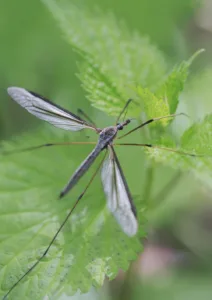
I stepped into my sunroom and found what looked like a giant mutant mosquito clinging to my screen door. Built like extra-large, spindly-legged versions of mosquitos they often trigger immediate panic. However, there is no need to reach for the fly swatter or the bug spray. These long-legged visitors are crane flies, and despite their alarming appearance, they are completely harmless to humans and pets.
Belonging to the insect family Tipulidae, crane flies are one of the largest groups of flies in North America. As larvae, they are often referred to as "leatherjackets" because of their tough outer skin. Crane fly larvae typically live in moist soil, mud, or under decaying leaves. During this stage, they can be highly beneficial to your home landscape. The larvae act as nature's recyclers by breaking down decomposing organic matter and enriching the soil. While a few specific members of the species can occasionally be a nuisance to turfgrass in very wet conditions, the vast majority of crane flies are an important and healthy part of the local ecosystem.
Once they emerge as winged adults, their lifespan is incredibly brief, often lasting just a few days. Their sole purpose at this point is to mate and lay eggs with the females laying between 200 and 300 eggs over her reproductive period. In fact, most adult crane flies eat very little, if anything at all, surviving only on occasional nectar.
Because of their long legs and similar body shape, crane flies are often confused with mosquitoes. They have even earned the popular, but totally inaccurate nicknames such as "mosquito hawks" and "skeeter eaters". University extension programs, including Ohio State University BYGL and University of Florida IFAS, highlight several key differences to help you properly identify them.
The most critical difference is that crane flies do not bite. They completely lack the piercing-sucking mouthparts that mosquitoes use to feed on blood. Because they do not bite, crane flies cannot transmit diseases. There is no health risk associated with them. Despite their nickname as "mosquito hawk," they are not predators and do not feed on mosquitoes. Having them in your yard will not decrease the mosquito population. Finally, their movements are significantly different from mosquitoes. While mosquitoes are agile, precise flyers, crane flies are remarkably clumsy in the air. They tend to wobble aimlessly and are easily battered by a light breeze.
When you encounter a crane fly indoors or congregating around your home's exterior, the best approach is to just leave it alone. Like many insects, they are highly attracted to light. If you find them gathering in large numbers near your entryways, simply turn off your lights or switch to yellow "bug-safe" LED bulbs.
Ultimately, crane flies are a natural part of many ecosystems and often require no intervention. The next time you encounter one of these gentle giants, you can observe it with curiosity rather than fear.