
Trending
FROM KING FEATURES SYNDICATE, 300 W. 57th STREET, 41st FLOOR, NEW YORK, NY 10019
CUSTOMER SERVICE: (800) 708-7311 EXT. 236
CONTRACT BRIDGE — BY STEVE BECKER #12345_20261001
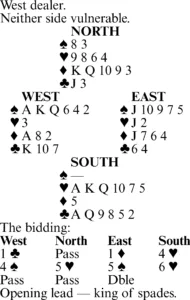
This deal occurred during a match between Australia and a Panama-Venezuela team at the 1979 world championship. It features the type of elementary error that one would not expect to see in an event at this level.
The Panamanian West opened one club, an artificial bid indicating at least 16 high-card points. The Australian South eventually wound up in six hearts doubled after the bidding shown, and West led the king of spades.
Declarer ruffed, played the A-K of trump and led a diamond toward dummy. West wisely went up with the ace, but then -- afraid declarer might dispose of his club losers on dummy’s diamonds -- shifted to a club at trick five. As a result, South made the slam and scored 1,210 points.
West’s fears were completely unjustified. It was impossible for South to hold a hand with which he could make six hearts after a spade or diamond return at trick five.
Declarer was already known to have started with no spades, six hearts and one or more diamonds. West could therefore reason that if South had only one diamond, he had six clubs; if South had two diamonds, he had five clubs; if South had three diamonds, he had four clubs; and if South had four diamonds, he had three clubs.
These were the only possibilities, and in every case, South would have to lose either one or two club tricks, depending on whether declarer or East had the ace of clubs. The neutral return of a spade or a diamond at trick five was therefore certain to defeat the contract, while a club return could not possibly gain and might easily prove disastrous.
Tomorrow: Bidding quiz.