
Trending
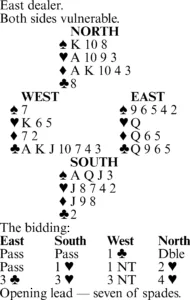
This hand was played in the Vanderbilt Team Championship in 1934. West was Ely Culbertson, then at the height of his career, playing with his favorite partner, Ted Lightner.
Culbertson tried to talk his opponents out of a game by bidding one notrump and three notrump, ostensibly showing all-around strength. But North-South paid him no heed and got to four hearts anyway.
Culbertson led his singleton spade, won by declarer with the jack. South played a heart to the ace, catching East’s singleton queen. Dummy’s ten of hearts then lost to the king, whereupon Culbertson returned a low club.
Lightner won with the queen and had no difficulty diagnosing the purpose of West’s underlead of the A-K of clubs. He returned a spade for Culbertson to ruff, and Lightner later scored the diamond queen to set the contract.
The three-club bid by Lightner had pretty well marked him with the queen of clubs; without it, he could scarcely have bid at all. But even if Lightner had not supported clubs, Culbertson’s underlead of the A-K would still have been the right play, since a spade ruff offered the only realistic chance to defeat the contract. With a vulnerable game at stake, the 30-point overtrick that might have been yielded if South had the queen of clubs was too negligible a factor to consider.
When the same hand was played at the other table, Culbertson’s teammates bid and made four hearts with the North-South hands, producing a net gain of 720 points on the deal.
West sealed his fate at this table when he chose the king of clubs as his opening lead. Even though he shifted to a spade at trick two, there was no longer any way for East to give West a spade ruff, and declarer made the contract easily.
Tomorrow: The magic number 13.
(c)2026 King Features Syndicate Inc.