
Trending
One of the fundamental rules of the game is that a player must follow suit whenever he is able to do so. Everybody is familiar with this rule, of course, but not everybody knows how to take full advantage of it.
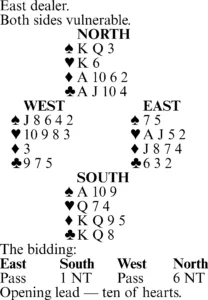
Take this case where West led the ten of hearts against six notrump. Dummy’s king lost to the ace, and East returned a heart to declarer’s queen. South now had to take the rest of the tricks to make the slam.
He could count for certain on three spades, a heart, three diamonds and four clubs — a total of 11 tricks. The only possible chance for a 12th trick lay in diamonds.
If the diamonds broke 3-2, the slam was sure to make. But since either defender might have been dealt four diamonds to the jack, the slam was far from a certainty.
South saw that four diamond tricks could be made even against a 4-1 break, provided he knew which opponent had the diamond length. If either opponent had four to the jack, and South played his high diamonds in the correct order, he could guarantee a successful finesse against the player with the jack.
In order to determine which opponent was apt to have the greater diamond length, South cashed all his spade and club tricks. In the process he discovered that West had started with exactly five spades (East did not follow to the third spade), plus three clubs and at least two hearts. With 10 cards in those three suits thus accounted for in West’s hand, it was impossible for him to have started with four diamonds.
Accordingly, South cashed the king of diamonds and led a low diamond to the ace. When West showed out, the finesse against East’s jack became marked, and the slam was home.
Note that if declarer had started the diamonds by cashing the K-Q first, he would have gone down.
Tomorrow: Basic card-reading.
(c)2026 King Features Syndicate Inc.