
Trending
It is usually more difficult to defend correctly than to declare correctly. This is mainly because declarer starts out knowing exactly how many cards his side has in each suit, which honor cards he has, and which ones are missing.
Conversely, each defender starts without knowing his partner’s high-card strength or the number of cards his partner holds in each suit. Nevertheless, if the defenders work as a team, they will nearly always score every trick to which they are entitled.
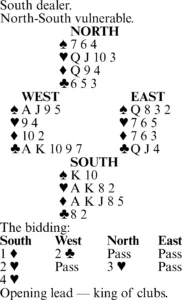
Here’s an example of good partnership rapport. West leads the king of clubs, on which East plays the queen. East’s queen play indicates the ability to win the next lead of the suit, either because he holds the jack or because the queen is a singleton.
Accordingly, West next leads a low club, knowing his partner will win the trick unless declarer has no more clubs. East takes the jack and, realizing West would not have overcalled two clubs with fewer than five of them, shifts to the deuce of spades.
West takes declarer’s king with the ace and, because East’s fourth-best (or third-best) spade return marks South with at least one more spade, continues with a spade to set the contract. In doing so, West resists the temptation to try to cash the ace of clubs at trick four.
Observe how smoothly East-West cooperated to find the killing defense. East had to signal with the queen at trick one to induce the crucial low club return by West at trick two. East also knew the futility of continuing with a club at trick three, which would have handed declarer the contract. His shift to the spade deuce at trick three, implying an honor card in the suit, simultaneously allowed West to deduce that South had at least two spades and enabled West to put the last nail in the coffin at trick four.
Tomorrow: Bidding quiz.
King Features Syndicate Inc.