
Trending
Most players have little or no interest in just how percentage plays in bridge are determined. Nevertheless, the fact remains that success at the game is highly unlikely without at least a working knowledge of basic bridge percentages.
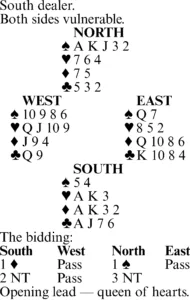
Consider this deal where South has very little hope for the contract unless he can make at least four spade tricks. The question, therefore, is how South can give himself the best chance to achieve this goal.
The best play, after winning the first heart, is to lead a spade and follow low from dummy, intending to cash the A-K of spades the next time the suit is played. This approach wins whenever the opposing spades are divided 3-3 (a 36% chance), or when they are divided 4-2 and the player with the doubleton has the queen (an additional 16%). The combined chance of success is thus about 52%.
If instead you lead a spade to the jack at trick two, your overall chance of success is only 36%. Whether the finesse wins or loses, you would need the opposing spades to be divided 3-3 in order to score at least four tricks in the suit.
Note that in the actual deal, declarer goes down two if he takes a first-round spade finesse but makes the contract by playing low from dummy on the first spade lead. Note also that if we exchange the East-West spade holdings and declarer finesses the jack, he goes down even though West has the queen but makes the contract if he doesn’t take the finesse!
It is somewhat startling to realize that, under certain conditions, a declarer can gain a trick by rejecting a winning finesse. But that is precisely what happens in this case if West has the Q-x of spades, while the refusal to finesse also gains if East has the Q-x.
Tomorrow: How to capture a damsel.
King Features Syndicate Inc.