
Feast Day celebrated at St. Columba
Trending
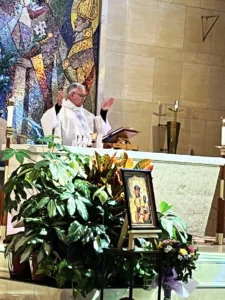
YOUNGSTOWN -- Members of Polish Youngstown and St. Columba Cathedral Parish came together to honor the feast day of Eastern Europe's most beloved Marian icons with a special Mass at St. Columba Cathedral.
The Aug. 23 celebration honored Our Lady of Czestochowa, also known as the "Black Madonna," and was followed by a festive Polish lunch reception featuring live entertainment. The luncheon was catered by Krakus Polish Deli & Bakery in Boardman.
Our Lady of Czestochowa has been a symbol of Polish identity, faith and resilience for more than 600 years. Her image, housed in the Monastery of Jasna Gora in Czestochowa, Poland, has inspired devotion worldwide. When Poles emigrated to the United States, they brought their devotion to the Mother of God, creating home altars and innumerable churches, chapels and shrines in her honor.
In every Polish church and many homes, her likeness is displayed as a reminder of her protective presence.
Aundrea Cika Heschmeyer, director of Polish Youngstown, said Our Lady of Czstochowa is considered the Queen of Poland.
"Her blessings are seen throughout Poland. She is credited with everything from winning wars, resolving conflicts and for getting rid of communism. We as a community are raised to pray to her. Every family has an icon of her in their home. We are so excited to be welcomed here to celebrate this today with the Diocese of Youngstown," Heschmeyer said.
The Rev. Msgr. Robert Siffrin, rector of St. Columba, said the Mass included traditional Polish hymns and a community rendition of "Czarna Madonna." He said the day was meant to show a meaningful celebration of faith, heritage and history.
During the Mass, readings were done in both English and Polish.
Siffrin said the day acknowledges "a wonderful reminder of our blessed mother."
Siffrin said Mary, the Blessed Mother, is known by many names.
"The wonderful word of Jesus is in her. She reminds us to do what her son tells us," Siffrin said.
Siffrin said the devotion to the Lady of Czestochowa has been done for thousands of years.
"She is a source of encouragement and protection in the face of adversity, She is there when people face times of trial and hardships and especially helped those during World War II and facing communism," he said.
In 2010, former Bishop George V. Murry enlisted Polish Youngstown's help to initiate an effort with the parish of St. Columba Cathedral to renovate the baptistery into a shrine to Our Lady of Czestochowa. This was done to welcome the parishioners of St. Casimir and St. Stanislaus Kostka -- both primarily Polish churches -- into the cathedral parish upon the closure of their churches.
Financial campaigns and contributions from PolishYoungstown, the St. Casimir Society and Cathedral parishioners made this effort a reality.
The parishioners of St. Stanislaus on the city's South Side bestowed their mosaic icons as the shrine's centerpiece. The icons are an enduring symbol of the Black Madonna's sacred mission as protector of Poland and her people everywhere.
The Shrine was dedicated on Oct. 30, 2012 and is available for devotion whenever the Cathedral is open.
According to tradition, the icon was painted by Luke the Evangelist on a tabletop built by Jesus himself and arrived in Poland in 1382 with a Polish army fleeing the Tartars.
It is said that the presence of the holy painting saved its church from being destroyed in a fire, but not before the flames darkened the flesh-toned pigments.
The Black Madonna is credited with numerous miracles. The most famous occurred in 1655, when Swedish troops were about to invade Czestochowa. Polish soldiers prayed fervently before the icon for deliverance, and the enemy retreated. In 1656, King John Casimir declared Our Lady of Czestochowa the "Queen of Poland" and designated the city as the nation's spiritual capital.
During Nazi occupation, Hitler prohibited pilgrimages to Jasna Gora, but many still secretly made the annual journey. Today, it is the third-largest Catholic pilgrimage site in the world. It is considered Poland's national shrine and spiritual capital.