
Trending
If someone aims a gun at your head, it is a good idea -- as a matter of self-preservation -- to disarm him if you can.
An analogous situation sometimes occurs at the bridge table when a particular opponent poses a threat to your contract. In that case, you try, if possible, to eliminate the threat.
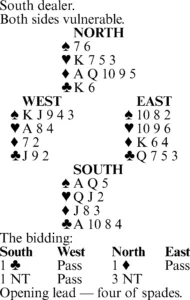
Let's say you're declarer at three notrump in today's deal. West leads a spade -- presumably fourth-best -- and you win East's ten with the queen. You see that the contract can easily be made if West has the king of diamonds. In that case, repeated finesses would in all likelihood yield five diamond tricks, after which you can drive out the ace of hearts to finish with 11 or 12 tricks.
If the diamond finesse loses, however, East will return a spade to establish West's suit. Then, if West started with more than four spades and also the ace of hearts, you will go down.
Once you reach this point in your considerations, you might see the advantage of leading the queen (or jack) of hearts at trick two instead of taking an immediate diamond finesse. Indeed, this play should virtually assure the contract.
West is the dangerous opponent, but he can be disarmed by leading the queen of hearts before you do anything else. If he has the ace and takes it, you intend to duck the spade return and win the next spade.
Now when you take the diamond finesse, you are on safe ground. If the finesse loses, either East will not have a spade to return (because he started with only three of them), or East will lead a spade (because he started with four of them). In either case, the contract is safe.
Of course, if West does not take the first heart, you can then try the diamond finesse with impunity to finish with at least nine tricks.
Tomorrow: Bidding quiz.