
Trending
There's surely something paradoxical about the statement that bridge is a relaxing game, when the fact is that you can't ever afford to relax -- if you want to do well.
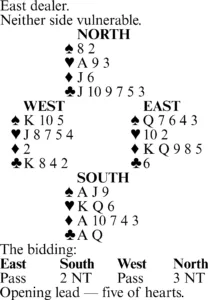
Take this hand, for example, where West leads a heart against three notrump. Declarer plays low from dummy and wins East's ten with the king. He then cashes the ace of clubs and continues with the queen, but West plays low, and East shows out.
This is a disappointing development for South, because if West had taken the king, a minimum of 10 tricks would have been ensured.
But South sees there is still a chance to establish the club suit, so he leads a low heart and, after West plays low, finesses the nine. When the nine wins, he leads the jack of clubs, forcing West to take the king either now or on the next trick, and South's troubles are over.
The finesse of the nine is certainly unusual, since South started with three sure heart tricks and appears to be jeopardizing one of them. Nevertheless, it is necessary because he needs an extra entry to dummy to establish the clubs and then get back to cash them later.
However, the fact is that West was asleep at the switch at the critical point in the play. Having smartly refused to take his club king at trick three, he relaxed at trick four –and, as we said at the start, you just can't afford to do that in bridge. When South led the low heart toward dummy's A-9, West should have put up the jack. Had he done that, nothing could have saved the contract.
West knows from East's play of the ten at trick one that South has the king and queen of hearts. West should therefore try to prevent declarer from gaining an extra entry to dummy by inserting the jack when South leads the six. It can cost West nothing to make this play and might wind up gaining him a great deal.
Tomorrow: The Grand Slam