
Trending
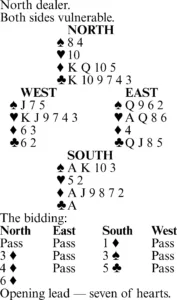
Opening lead -- seven of hearts.
The arithmetic of bridge dictates that a small slam should be bid whenever the chance of making it is better than even. This is because if you bid and make six, whether vulnerable or not, you gain just about as many points as you'd lose if the attempt failed.
This means that if your chance to make a slam is clearly better than 50 percent, you should be eager to reach it, while if your chance is 100%, it would be an egregious error not to bid it.
These general principles mean very little if a partnership fails to utilize the abundant criteria that point the way to a slam. Point count is helpful but not always reliable, while Blackwood and similar devices might settle an ace problem without settling the question of whether 12 tricks can be made.
Accuracy in slam bidding relies mostly on everyday logic. A partnership attempts to exchange all the information it can and then makes its decision as to whether a slam will be a viable proposition.
Note that in today's hand, South cannot single-handedly undertake the diamond slam because, for all he knows, the opponents might be able to cash the first two heart tricks. He therefore shows his spade and club controls and, in this way, inferentially asks his partner to bid six if he has first- or second-round heart control.
North, with a singleton heart, should comply, for he can be sure that South has three aces and an excellent hand to justify two probes for a slam. Twelve tricks are easily made, even though the combined high-card point count is only 24.
Tomorrow: Bidding quiz.