
Sunflowers: Wonder of science and beautiful
Trending
Sunflowers are amazing as well as a wonder of science.
There are more than 60 varieties and some are multi-stalked. It is the national flower of Russia. To begin with, sunflowers are dicots, meaning their seeds have two cotyledons, or embryonic leaves. The plant usually grows from a single, hairy, upright stalk with a soft, pithy interior, somewhat similar to a cornstalk.
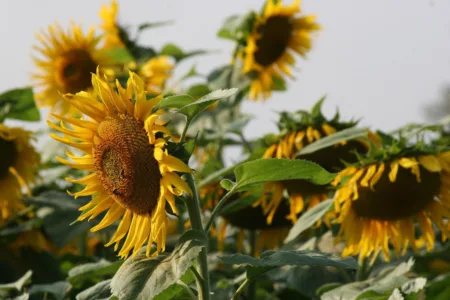
The flowers themselves are a marvel. Although we see what appears to be one large flower, a sunflower head is actually made up of hundreds or even thousands of individual flowers. The center is composed of numerous disk florets, which contain both male and female reproductive parts and can develop into seeds. Around the outer edge is a ring of showy, sterile ray flowers -- the structures we commonly think of as petals.
The blossoms as well as the seeds are arranged in spirals going to the left and right. Each floret is situated 137.5 degrees, or the golden angle, making the pattern of interconnecting spirals.
The Fibonacci numbers of 34 in one direction and 55 in the other; in large blossoms it is 89, and 144, that continue to amaze and baffle scientists. What this all means is that this pattern allows for very efficient packing of seeds within each flower head. Beautiful math lessons for our little ones.
The sunflower loves to grow in the sun (of course). When young, before they begin to bloom, sunflowers follow the sun. Each morning they are situated to follow the sun all day until sunset. As the buds begin to open, the plant stops following the sun and the flower head generally becomes fixed facing east, steadfast and unyielding, as the plant focuses on reproduction and seed production.
The seeds of the sunflower are packed with oils and are an important food for people and animals: sunflower butter (much like peanut butter), cosmetics, flour, forage for animals, birds, livestock, and, of course, people.
Other important facts about these fascinating flowers -- North and South Dakota boast 85% of America's production; 80% of the value of sunflowers is oil production; and they make a great biofuel because of their ability to grow in many soil types.
It is simple to raise sunflowers in your home garden. They love full sun and water in addition to well-drained soil. If they get too tall, simply add a stake.
They are low maintenance, but the enjoyment and pleasure of seeing them in the garden is invaluable. They are great for children because of the basic connections to science and the sun.