
Trending
Most books on play include a section that tells you how to handle the most frequently occurring card combinations. But because many other less common combinations are not included, it becomes important to learn how to solve such problems all by yourself.
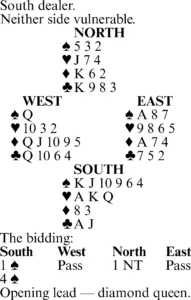
Take this deal where South is in four spades and three rounds of diamonds are led, declarer ruffing the third. He crosses to dummy's only entry, the king of clubs, and leads a trump, on which East plays the seven.
Declarer is now faced with a crucial problem: Should he play the jack or the king? In attempting to solve this problem, South dismisses all those cases where his play makes no difference. Thus, if West has a void, the singleton eight, the singleton ace, the A-Q or the A-Q-8, South is certain to lose two tricks in the suit whether he plays the jack or the king.
This leaves only those hands where West was dealt the A-8 or the Q-8 (in which case tossing a coin is as good a solution as any), and hands where West started with the singleton queen.
It is when you reach this point that the correct play becomes apparent: The king is the right play, since it wins in two cases -- when West started with the Q-8 or the singleton queen -- while it loses only when West started with the A-8.
In effect, declarer eliminates from consideration all hands where the missing trumps are divided 2-2 or 4-0 because his cause is either hopeless or amounts to a 50-50 guess. The only case that matters is when the trumps are divided 3-1 and West has a singleton honor.
If West's singleton honor is the ace, South cannot succeed whether he plays the jack or the king. But if West's singleton honor is the queen, playing the king catches the queen, and declarer loses only one trick in the suit.
Tomorrow: Test your play.