
Trending
I was asked to write an article on the blue-winged wasp, and it was opportune as I have seen a few in my yard.
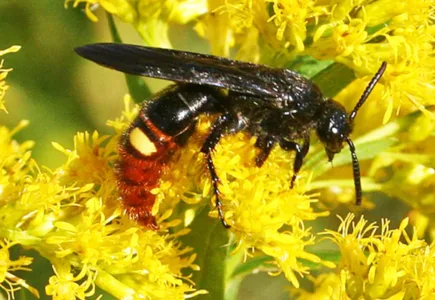
This inch-sized wasp (Scolia dubia) is an amazing, wonderful, benign member of the group called solitary wasps.
These wasps do not build communal nests or work together in colonies with others of their species. Instead, individual females independently locate and provision their offspring, completing their reproductive cycle without the cooperation of a colony.
Beginning in June, these wasps emerge from the soil as an adult to mate, feed on nectar and pollinate flowers. They are black to a sheen of blue, with fuzzy bodies that from the second abdominal segment is a bright shade of mahogany red, with two large creamy yellow dots behind the wings. Eye catching and beautiful. Males are smaller than females, being three-quarters of an inch to 1 inch.
Males and females perform courtship dances low over lawns, fields and roadsides in a figure "8" or an "S" shape to mate. After mating, she hunts out the larvae of the June beetle (Cotinis nitida) and the Japanese beetle (Popillia japonica), the invasive bane of the gardener's existence. These grubs are just below the surface. She finds one, stings it to paralyze it, lays an egg that she attaches to it, then buries it lower into the soil.
When the larva hatches, it immediately begins feasting on the grub, then pupates in a cocoon, and will either emerge as an adult, or, if later in September, stays in the cocoon to overwinter. The mature larval stage can overwinter in the soil.
Adults spend the summer breeding and eating pollen from the abundance of flowers. In passing, they inadvertently pollinate other plants. Adults live for a year, the cycle explained above.
Males have no stingers, but females will sting if mishandled. Males emerge earlier to begin their quest to eat and reproduce. They will hover low over the land to search out and find the first females to mate.
During and after mating, many males gather together to curl up to sleep on one branch or plant and socialize and rest. Mated adults die in the fall. Grubs and other larvae are hunted by skunks, armadillos, raccoons, birds, and many other animals and insects. This includes blue-winged wasp larvae, so that is the reality.
These are one of the best insects to have in your yard. They pollinate, they prey on grubs and they are so mild mannered.