
Trending
It has been said that nothing is certain except death and taxes, but the knowledgeable bridge player would add to these the maxim that each player is dealt 13 cards. The backbone of good card play, both offensive and defensive, rests on this simple truth.
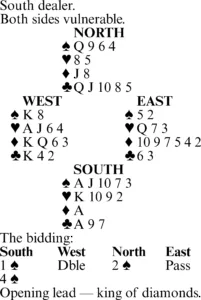
Take this case where West leads the king of diamonds against four spades. Declarer wins and plays the ace and another spade, losing to the king. West tries to cash the queen of diamonds, but declarer ruffs.
South crosses to dummy with a trump and tries a club finesse, losing to the king. If West, eyeing dummy's clubs, now gets panicky and plays the ace of hearts because he is afraid South will discard his heart losers on dummy's clubs, he hands declarer the contract.
West may make this play because he thinks the only chance to stop the contract is to hope East has the king of hearts. However, this reasoning is unsound, to say the least. West should return a club instead, because he cannot lose anything by doing so.
West has all the information he needs to make the club return completely safe. He knows South started with exactly five spades and one diamond, leaving declarer with seven cards in hearts and clubs.
If South has two clubs, he must have five hearts; if he has three clubs, he must have four hearts; if he has four clubs, he must have three hearts. In all of these cases, South cannot escape whatever heart losers he has.
Consequently, West's only correct action is to return a club at trick seven and let nature take its course, which in this case results in down one. The danger that South's heart losers will somehow disappear is more imaginary than real.
Tomorrow: Bidding quiz.
(c)2026 King Features Syndicate Inc.