
‘You have to be an instant expert’
Trending
CANFIELD -- Life imitated art when the first pope from the United States was selected in May 2025 at the Sistine Chapel's gathering of cardinals.
When the 2024 film "Conclave" was released -- the movie chronicled the selection of a new pope -- no one could have imagined that in less than a year an actual conclave would begin, with a new pope announced on May 8, 2025. Robert Prevost of Chicago became Pope Leo XIV.
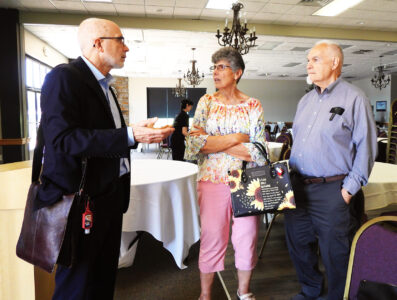
"I saw the movie and it was actually pretty good. This is my third conclave. Hopefully, it is my last," said David Gibson, Ph.D., director of Fordham University’s Center on Religion and Culture. He presented "American Pope, American Church: What Leo XIV means for American Catholicism" at the First Friday Club of Greater Youngstown's monthly luncheon June 4 at Avion on the Water.
"Becoming pope is a disorienting thing. You fly to Rome. He was living there, luckily. You go to a conclave. You put on a white suit that you never take off. They give you a name that is not yours and an address that you have never lived in before," he said.
His talk included the process of selecting a pope and other inside knowledge he acquired while working for Vatican Radio and religious media.
In 1986, Gibson worked in Rome at Vatican Radio. While covering Pope John Paul II and witnessing the work of priests and sisters, a 30-year-old Gibson converted to Catholicism.
"I got my start in journalism working for an English program, the Jesuit-run Vatican Radio. I was Protestant at the time. Thank God for the Jesuits. They always protected me when the pope sent the secretary of state over and he asked, ‘Why are we paying a Protestant to be on the payroll?' They would always say, 'Well, he's taking instruction,' which I was," Gibson said.
After a short history of conclaves throughout the centuries, Gibson's talk focused on three points: Who is Robert Prevost? How was he elected pope? And what does it mean for the church in our world?
Besides talking about Pope Leo XIV's family life as the youngest of three boys in Chicago and his love of the Chicago White Sox, which Gibson jokingly said “helps him know suffering," the speaker then discussed Prevost's religious order.
"He is an Augustinian monk. Pope Francis was the first Jesuit pope in history. Leo is the first Augustinian pope," Gibson said.
He said that “people say the church doesn't change," but then cited instances to debunk that view.
“In the last almost 50 years, there was the first Polish pope, who broke the Italian stranglehold. The first pope to resign. The first German pope. The first Jesuit pope from South America, and now the first American pope," Gibson said.
He believes that Pope Leo's Augustinian order is perfect for the times of chaos in the world because it stresses living in community and outreach to the poor.
The education of Robert Prevost includes being a math major, which in Gibson's opinion makes him very precise, and he is a canon lawyer, which involves the legal principles made and enforced by the Catholic hierarchy.
"He plays Wordle. I loved Francis, but he would fly off the handle on occasion. Robert Prevost is very calm. He has a great sense of humor. He loves to play tennis. The day after his election, there was an interview with his personal trainer in “Il Messaggero” (the Rome newspaper). The guy thought he was just an American priest, then he saw him walk out on the balcony. He rides a horse. He is a missionary. He spent much of his life in Peru," Gibson said.
He mentioned that of 267 popes, only the last 26 were elected from the Sistine Chapel with a two-thirds majority. He said the white smoke that signals the election of a new pope began in 1914.
"They burn the ballots for secrecy. Dry straw comes up as black smoke and wet straw comes up white, but it is usually gray. In 2005, they brought the journalists up to show the new stove with cartridges of black or white. They did something wrong and smoke billowed into the Sistine Chapel when they didn't close the door. This time it was much better," he said.
"Nobody knows what is going to happen. I've covered the Vatican. I've covered three conclaves. One hundred and thirty-three cardinals went into this conclave, the largest in history. Any one of them could have come out on the balcony and you have to be an instant expert. It is not easy," Gibson said.
He showed the betting odds on a site of who would become pope. Pope Leo was 35 to 1.
"As soon as you turn 80, you lose your right to vote as a cardinal in the conclave. The cardinals are from all over the world and requested name tags to know who each other is," he said.
He pointed out the two dynamics in the conclave that are somewhat similar to the movie -- the conservatives wanted to take back the papacy and the Italians wanted to take it back, saying it is theirs.
"The first ballot is kind of vote for your friend. You needed 89 to have two-thirds to become pope," Gibson said, noting Pope Francis had appointed 80% of the cardinals in the conclave.
Since Pope Leo's ministry prior to becoming pope was as a missionary in Peru, Gibson dubbed him "the first global pope for the global church. He was a world traveler and speaks Italian."
English is the unofficial official language of the Vatican. Many of the cardinals are not European, so it is an advantage that Pope Leo speaks English.
"He knows Spanish. I talked to many African cardinals and Asian cardinals who were happy they could speak English to him," Gibson said.
"Who is Pope Leo? He is a unifier. He dresses like Benedict and talks like Francis. He was described as the least American of the Americans. Last May, they were voting specifically for an American pope, but for many of them, and some of us, he represents the America that they feel is disappearing," Gibson said.
He clarified the specifics of Pope Leo's qualifications.
"The cardinals chose an immigrant, multi-ethnic, internationalist Catholic who prides himself on dialogue and charity for the common good. Mixes high ideals with principled pragmatism, very American, and they chose him just as America is turning on itself and away from many of those virtues. American Catholicism is a church of immigrants, much as America is a nation of immigrants. Only 5% of the world's Catholics are Americans," Gibson said.
In citing the cardinals’ reason for voting for Prevost, Gibson surmised it is what they would like America to return to, the best of America.
"So, perhaps the question Leo's election ought to prompt is not how American he is, but how American and how Catholic we are," he said.
As part of the prayer before lunch, First Friday Club of Greater Youngstown's Chairman of Programming, Mary Ellen Brannigan, read a poem written by Eileen Novotny, a longtime attendee of the luncheons. She died in October 2024.