

March 6: Bridge by Steve Becker
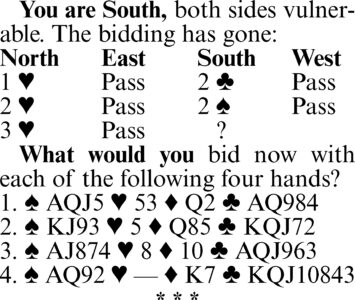
1. Four hearts. Naturally, you are reluctant to raise partner with only two trumps, but there are times when you have to. It is certainly reasonable to assume partner has at least six hearts after he has bid the suit three times, so any two trumps constitute sufficient support.
Since you have a sound opening bid facing an opening bid by partner, a game contract is clearly indicated. With partner unable to support clubs or spades, and apparently unwilling to play notrump, there is no other choice but to undertake the game in hearts.
2. Pass. By bidding in minimum terms twice after opening with one heart, partner has unquestionably indicated a weak opening bid. Both his rebids show a willingness to play at less than a game contract. So the question to be resolved is whether your hand is good enough to justify bidding a game.
All signs point to a pass. Promising as your hand might have been when partner opened the bidding, his subsequent bids have substantially reduced your values. Partner lacks a fit in clubs or spades, and you have no fit for hearts. Game is therefore very unlikely.
3. Three spades. This depicts your 6-5 distribution and should make it easier for partner to choose the best contract. Since you would not have bid spades twice with only a four-card suit, partner now knows you have five spades. At the same time, he has learned that you must have at least six clubs, since you would have bid spades first had the two suits been of equal length.
4. Five clubs. Given partner’s weak bidding to this point, all thoughts of a slam must now be abandoned. However, to play at less than game is also out of the question, despite partner’s obvious lack of enthusiasm.
You can play with clubs as trump even if partner has a singleton or void, so, since the hand is too unbalanced for notrump play, a leap to game in clubs appears to offer the best chance.
Tomorrow: Eliminating the impediments.
Lifestyles

Protect yourself for allergy season
Mercy’s inaugural Impact Dinner set for April 8
The Mercy Health Foundation Mahoning Valley will host its inaugural Impact Dinner at Stambaugh Auditorium on April ...
HINTS FROM HELOISE: Psyllium is great way to start day
DEAR HELOISE: Some readers prefer fiber pills, but I like to take a different route. I am 75 and have been taking ...
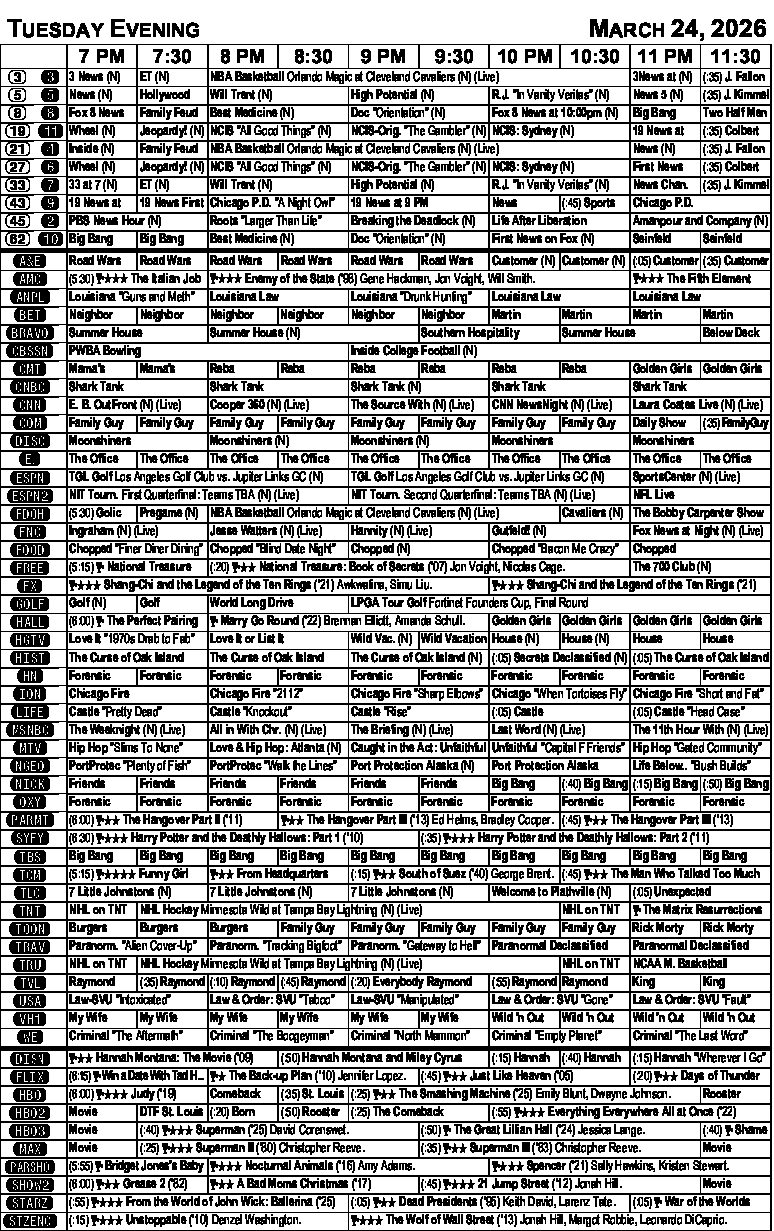
Tuesday evening TV listings
How long will nicotine patches improve memory?
Q. I read in your column about nicotine patches helping with memory. I have been trying them, and I do feel ...
DEAR ANNIE: When a friend’s ‘help’ feels like a put-down
DEAR ANNIE: I’m having a problem that feels small, but it’s starting to make me dread seeing someone I care ...