Woods under attack
Beech leave disease plagues majestic Ohio trees
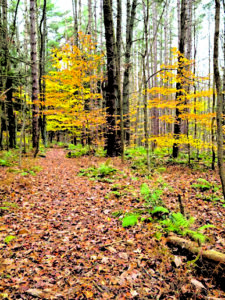
Submitted photo These young marcescepts of young American Beech trees retain their leaves well into winter.
While on a childhood hike through a neighborhood woodlot with my dad, my earliest memory of beech trees is noticing that the smooth gray bark served as a billboard to announce local romance. Two sets of initials inside a heart carved into the bark was a woodland Valentine of sorts.
The American Beech (Fagus grandifolia) is a stately native tree, sometimes reaching heights of over 100 feet in a mature forest. Trunk diameters can range from 2 to 3 feet, and trees can have a longevity of 200 to 300 years, at least they used to. The smooth, gray bark makes them easy to identify in the winter woods.
The trees are marcescent, meaning they retain their leaves well into winter, another easy identifier. Beech is native to eastern North America, and beechnuts are mast (food source) to many local wildlife.
Since 2012, American Beech trees have been under attack. Beech Leaf Disease was first identified in Lake County in 2012, and as of 2025, is found in 15 states and eastern Canada. In our area, it was identified in Trumbull County in 2016 and Mahoning and Columbiana in 2018.
It can also affect ornamental cultivars but our native American Beech trees are especially vulnerable.
Historically, disease and insects have devastated populations of chestnut, elm, and ash, and scientists fear for the future of our beech.
Ironically, the disease was first detected almost at the doorstep of Holden Arboretum on the border of Lake and Geauga counties, and the arboretum is leading research into the disease. Dr. David Burke, vice president for science and conservation, reported that 30% of their trees have died with mortality highest among 4- to 5-year-old saplings.
BLD is caused by nematodes, microscopic roundworms, that infest leaf buds. According to Cornell University they live and reproduce in the leaf buds at the end of branches through fall and winter. In the spring, emerging leaves show the light and dark banding between veins that is an indicator of the disease.
Symptoms are often first observed on lower branches, though the reasons for this pattern are not fully understood. Over time, leaves distort and turn brown. Mature trees show thinning of the canopy and slower growth.
In 2024, Dr. Burke announced results of trials, in collaboration with Bartlett Tree Labs, testing potential treatments for BLD. Treatments should only be applied by licensed professionals and restricted to high-value ornamentals. An arborist can be found at treesaregood.org.
Latest News
Woods under attack
Nation and world at a glance for Monday
Mexican army kills leader of powerful Jalisco cartel MEXICO CITY — The Mexican army says it has killed the ...

Final week of Black History Month events in the Valley
Canfield school officials explore tax-levy options
CANFIELD — The Canfield Board of Education hosted a recent special work session to discuss facilities, a possible ...
Bingo with a bang plays in Austintown