

This ‘hair’ turns out to be a worm
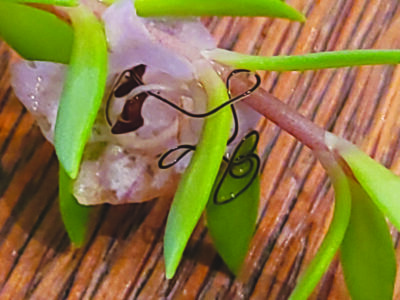
The convoluted horsehair worm wrapped around a plant easily can be mistaken for a string of hair. (Submitted photo)
On a walk past one of my garden beds after a nice rain, I noticed a hair from a horse’s tail tangled in one of my plants. That wouldn’t be surprising since chipping sparrows had been observed flying into a nearby arborvitae.
Chipping sparrows are nicknamed “hair birds” due to their habit of lining their nests with hair from the manes and tails of horses. We have plenty of horses in our neighborhood.
Taking a closer look, I noticed the hair was moving. Again, not surprising, the wind was blowing.
Removing the piece of plant with the hair attached, I came to the conclusion I was looking at a living thing as it continued to move when I took it indoors.
An app on my phone identified it as a horsehair worm. It was a new-to-me critter.
Horsehair worms also are called Gordian worms. Because they contort themselves into a tangled knot, they are named after the Gordian Knot of ancient Greek legend.
The worm can range from 4 to 14 inches in length and is 1/25 to 1/16 of an inch in diameter. Young worms are white and turn tan, yellow, dark brown or black as they mature. They are found in wet areas, including near streams or ponds, puddles, watering troughs, bird baths and even toilets. More about how that happens later.
The life cycle of a worm begins when a male and female mate in freshwater or wet soil. A female lays millions of eggs in long strings that wrap around plants. The hatching larvae are 0.01-inch and may form cysts on plants near the water or may be in the water. Scientists aren’t sure.
The larvae enter the bodies of arthropods such as grasshoppers, crickets, centipedes, cockroaches or even the occasional slug from the water or when cysts are consumed with plants. This begins the parasitic phase of the life cycle.
Once inside the host (the insect that has accidentally consumed the larvae) the juvenile worm bores a hole through the gut and into the body cavity.
The worm absorbs nutrients from the host through its body wall until it reaches adult size. Once mature, it exits the host when it is close to water. The host does not survive.
That annoying cricket hopping around the bathroom may be carrying a surprise when it is dropped into the wet environment of a toilet!
Adult worms do not eat; they live only to reproduce. Horsehair worms are not harmful to humans, livestock or pets, so no control is needed.
They can be thought of as beneficial, but they probably do not kill enough slugs, cockroaches or crickets to make a dent in their populations.
For more information, visit http://go.osu.edu/horsehair .
Steffen is an Ohio State University Extension Master Gardener Volunteer in Mahoning County.
Lifestyles
A trip back home and memories of Father’s Day
It is Tuesday at 5:30 a.m. My husband Joe and son Benjamin left for work. Son Kevin is still sleeping. All is ...
There’s a beef about beef at the World Cup
DALLAS — Drop thousands of Argentina fans into Texas for the World Cup and the debate is inevitable. It’s not ...

Great pie for the Fourth of July

WEDNESDAY EVENING TV LISTINGS
TO YOUR GOOD HEALTH: Rectal cancer treatment works well
DEAR DR. ROACH: My daughter, who’s 44 years old, was recently diagnosed with rectal cancer. It’s stage III and ...
HINTS FROM HELOISE: Honey of a tip from the Valley
DEAR HELOISE: If you put a jar of honey on a sunny windowsill to liquify it, make sure to place the container in a ...