
Do-Re-Mi!
Amphibians sing in the spring
Trending
High winds and gentle breezes bring our warmer temperatures. Usually this is the first thing we notice in spring, but the observation of our surroundings, especially listening, will increase your information and knowledge.
We think that male birds are "singing" when actually they are warning other males from their territory, choosing the nesting site and a mate.
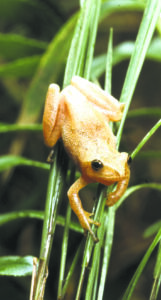
Many of us misinterpret the high-pitched sound as that of a bird when it is the spring peeper (Pseudacaris crucifer), a tiny frog with a dark "X" on its back.
Amphibians are emerging from their winter habitats and as much as we would like to think they are happily singing, frogs, toads and salamanders are looking for a mate, and trying to impress females with their calls, warning other males away. This serenade determines the battles between the males for territorial areas, and success is often determined by their voices.
Frogs and toads create the sound we hear by passing air through the larynx in the throat. Membranes of the skin enlarge during the call and is amplified by their vocal sacs.
These small amphibians can create a cacophony of piercing sounds that belie their small size.
Warm, humid spring evenings cause amphibians to emerge during the crepuscular (dawn and dusk) hours, and they are found in ephemeral (temporary) pools and deeper ponds where they lay their eggs near plants or debris. Hundreds of eggs are laid but many do not survive due to predation.
First to emerge and begin calling is the chorus frog (Psuedacris triseriata), 3/4 to 1 1/2 inches, whose call sounds like running a fingernail along a comb. Similar in size to the spring peeper, the peeper has been compared to a deafening high-pitched bell ringing.
The larger wood frog at 1 1/2 to 2 3/4 inches sounds like someone rubbing their thumb over a blown up balloon. It has a "mask" across its eyes and is mostly terrestrial.
Many other frogs can be heard, and if you listen carefully, you can distinguish which ones are nearby. An easily identified call is the green frog (Rana clamitans melanota) abundant in Ohio. At 2 1/4 to 3 1/2 inches it sounds like someone plucking the strings of a banjo.
More difficult to identify is the tiny cricket frog (Acris crepitans) with warty skin rather than a frog's smoothness. Its sound is just like its name, which often leads to confusion as to what you are hearing.
At 1 1/2 to 2 3/4 inches, the wood frog (Rana sylvatica) sounds just like a duck.
If you think you hear birds at night in the trees, you are hearing the gray tree frog (Hyla versicolor), a 1 1/4 to 2 inches frog, well camouflaged in trees where they can change their color from a gray-green to a light gray, depending on the background.
Finally, you won't miss the call of the bull frog (Rana catesbeiana) with the deepest and lowest call that sounds like its saying, "Jug-o-rum"
With so much activity around us during the spring, its interesting to just sit and listen to all the various evening sounds surrounding us, continuing their life cycle into the next generation.
To learn more about the northern spring peeper and listen to its calls, go to http://go.osu.edu/springpeeper.
-- Kane Shipka is an Ohio State University Extension Master Gardener Volunteer in Mahoning County.