
Stress creates witches’ broom
Nothing mystical about this infection problem
Trending
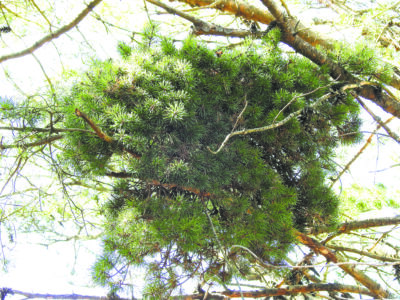
On my cranky days some might say it's my mode of transportation, but a witches' broom is really a deformity in a woody plant, typically a tree where the natural structure of the plant is changed.
A dense mass of shoots grows from a single point with the resulting structure resembling the sweeping end of a broom.
The term witches' broom comes from the German word Hexenbesen, which means to bewitch (hex) a bundle of twigs (besen). In medieval times brooms were made of a bundle of twigs and witches' were presumed to be responsible for anything unusual.
Now we know that witches' broom isn't caused by witches; it's actually caused by stress that is brought on by pests, diseases -- including anything from mites, aphids, nematodes to fungi, viruses and bacterial organisms. Improper pruning also may cause these brooms to appear. In addition, parasitic plants like mistletoe cause stress leading to formation of witches' broom.
Dwarf mistletoe can be deadly to its species-specific hosts. Severely infected trees should be removed, and other trees pruned to remove infection from lower limbs. It's spread may be halted by planting a different tree species between infected trees.
Trees aren't the only thing that can sprout brooms as it also affects shrubs, conifers and evergreens. The type of tree or shrub is a good indicator of its source of stress.
For instance, pine brooms are commonly caused by rust fungus. Fungal infections also can affect cherry trees and blackberry bushes. Peach trees and black locust can be affected by viruses that result in brooms. Mites can be responsible on willow trees and honeysuckle shrubs, while phytoplasmas lead to disease in ash and elm trees.
Witches' broom can last typically for the life of the tree providing nesting habitat for birds and squirrels.
There is no cure or treatment for witches' broom, but you can prune out the broom growth several inches below the point of its formation if you don't like the unsightly look of it. Although witches' broom does not kill trees by itself, it does deplete the tree of nutrients and slows down its growth. A heavily infected tree becomes weakened and vulnerable to the attack of other diseases or effects of weather, which can lead to the death of the tree.
The witches' brooms resulting from a genetic mutation retain their unique growth habits and pass this along to many of their seedlings offspring earning them the name of dwarf plants.
The dwarf evergreen growing in your landscape may have started as the twiggy stems of witches' broom. By cutting and grafting, these new plants are often propagated and sold as valuable landscape plants like Little Gem and Birds Nest Spruces.
To learn more about this, go to http://go.osu.edu/witchesbroom.
Baytos is an Ohio State University Extension Master Gardener Volunteer in Mahoning County.