
Experience awakening of new life
Trending
The vernal, or spring equinox, has arrived and with it comes many signs of spring. Because of the earth's movement on its axis, we will notice earlier mornings and longer evenings than in winter, with increased sunlight, which means more spring growth everywhere.
The most obvious changes are the buds on trees that eventually will become the flowers containing the seeds that assure the next generation of trees.
An early pollinator tree for bees was the red maple (Acer rubrum) with its tiny red hanging flower, a quarter inch, on a 1- to 2-inch stalk that grows in clusters. Pairs of red-winged seeds, called samaras, take flight in the breezes.
If you look closely, buds are forming on most trees by now.
With the earthy scent of spring rain emerge our spring flowers, a vitally important source for our pollinators. "No Mow May" is a catchy phrase to encourage us not to mow our lawns until after the month of May to provide spring flowers a chance to bloom, and provide access for the bees establishing their hives.
Dandelion, spring beauty, dead nettle, colts foot and snowdrops all emerge early, capturing the warm spring sun before tree leaves open. Bulbs we have planted last autumn are peeking through the soil with flowers budding. Daffodils have been greeting us along with another yellow flowering plant, the forsythia bush, one of the first to bloom.
While hiking in the woods, look for skunk cabbage, the May apple and jack-in-the-pulpit under the tree canopy.
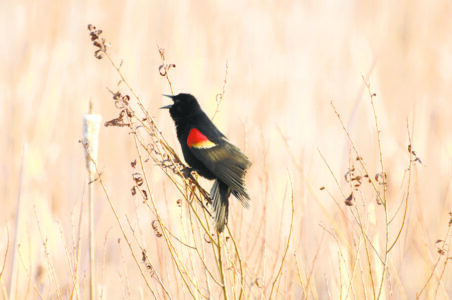
This is the perfect time for birders to observe what birds are either wandering in from the protection of the forest or migrating back to our area. The first returning bird is usually the red-winged blackbird (Agelaius phoeniceus), with conspicuous red epaulets in the male. Shortly behind is the robin, the bluebird and swallows searching for nesting sites. This is the perfect time, using binoculars, to identify the bird and its call.
Breezy, windy weather brings rain, which forms vernal pools that quickly dry up. Humid rainy evenings bring the calls of amphibians. Frogs, toads and salamanders, eager to breed, have emerged from wintering under rocks and leaf litter. Vernal pools are the perfect place to lay their ribbons of eggs that will hatch quickly, as these vernal pools dry quickly in the sun.
One frog easily identified is the Spring Peeper, with a distinctive "X" on its back, and light to dark brown coloration, 1 to 1 1/2 inches in length. Their mating call is a very high-pitched deafening "peep," amazingly loud for a tiny frog.
Walking in muddy areas might give the opportunity to find animal tracks. Raccoon and deer are easily identifiable, but taking a picture and using a reference book always helps in identification.
Many changes and new growth in our plants and animals happens quickly in spring, and gives them a chance to grow and thrive during the summer months.
This is a wonderful opportunity to experience the wonder of new life during our spring months.
To learn more about Ohio's wildflowers and watch videos of them, go to http://go.osu.edu/ohio
wildflowers.
Kane Shipka is a Master Gardener Volunteer for The Ohio State University Extension in Mahoning County.