
Never too young: Warren letter carrier suffers heart attack before 30th birthday
Warren letter carrier suffers heart attack before 30th birthday
Trending
WARREN -- Based on his family history, John Tutoki was expecting to experience issues with his heart.
A U.S. Postal Service letter carrier who walks 15 miles a day just didn't expect a full-blown cardiac arrest at age 29.
"I told my parents I was going to get checked at 30 because of my dad," Tutoki said. "I didn't even make it to 30."
The evening of Aug. 12, 2022 -- a month and three days before his 30th birthday -- Tutoki felt chest pains as he prepared for bed in his Warren home. "I had a pain in my left shoulder two days before," he said.
By the time he was in bed, the chest pains included his back, and was he sweating effusively. He knew this wasn't good.
Tutoki managed to get back downstairs and his fiancee called for an ambulance.
Shortly after the EMTs arrived, Tutoki collapsed in full cardiac arrest.
"They resuscitated me," Tutoki said. Minutes later, he was at Trumbull Regional Medical Center's Chest Pain Center and the Cardiac Catheterization Lab, where it was discovered he had a 95 percent blockage in a main artery and 50 percent and 40 percent blockages in two other arteries.
"Dr. (Fadi) Naddour came in at 10:30 at night to do the stent and save my life," Tutoki said. "My ejection fraction was 25 percent. Normal is 50 to 75 percent."
Ejection fraction is the measurement of the percentage of blood that leaves the heart each time it contracts.
"My biggest thing is I'm thankful it didn't happen when I fell asleep," he said.
"Since that day, everything is the road to recovery."
FAMILY HISTORY
What happened?
"Everybody asks me that because I'm so young," Tutoki said. "It's genetic and was slightly COVID-induced."
He was down with a coronavirus infection when the heart attack happened, which contributed, he said.
But mostly, it's family history, he said. Both parents had heart issues, and both of their fathers, plus aunts, other grandparents and assorted relatives suffered from heart diseases.
He knew that his father, John Sr., suffered a heart attack at age 32 while at a Cleveland Indians baseball game, and that he had a triple-bypass at age 35.
"Me and my dad are copies. I'm John Jr. for a reason," he said.
That's why he planned to begin heart check-ups when he turned 30. What he didn't know was the his dad had a "silent heart attack" at age 27.
A silent heart attack is one in which the victim has few or no symptoms. Evidence of a heart attack can be seen by tests such as an electrocardiogram or echocardiogram.
Now he encourages family members to get checked.
"I have a brother who is 11 months and 15 days younger than I am. He just made an appointment," Tutoki said. He's concerned about his sister, as well. Tutoki said he's done a lot of research since his heart attack, and among the things he read is that heart disease is more common in women.
And then there's his little boy.
"We're going to be proactive on that," Tutoki said. "That's set in stone. Hopefully, he got more of his mother's genetics."
Other factors included a so-so diet and that he smoked.
"It's all about what's inside," Tutoki said.
ROAD TO RECOVERY
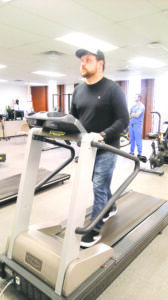
Two days after leaving the hospital, Tutoki began workouts at Trumbull Regional's Cardiac Rehabilitation Program. He went three times a week for 36 sessions in all.
Certified by the Cardiac Rehabilitation Program by the American Association of Cardiovascular and Pulmonary Rehabilitation, the program features education, counseling, support for patients and families and a variety of heart-strengthening exercises.
"They make you feel like it's not a chore. They make you want to exercise," Tutoki said. "It's not about pushing yourself too hard. They want slow gains.
"They care. That's the biggest thing," he said. "My ejection rate went up to 48 percent. It's still going up.
Since graduating rehab, Tutoki has continued exercises at a local gym. His workouts include plenty of cardio exercises and weightlifting. "It's definitely something everybody should do," he said.
At the recommendation of his rehab team, Tutoki is following the DASH diet, and has an app set up on his phone to track himself.
The DASH diet emphasizes vegetables, fruits and whole grains, and fat-free or low-fat dairy products, fish, poultry, beans and nuts. It limits saturated fats.
"I've lost 22 pounds with the DASH diet," Tutoki said. "I never ate the greatest, but not terrible. I didn't do fast food."
"It's definitely life-changing," Tutoki said.
His age and his job with all its walking -- Tutoki is back on his postal route -- would make one think he didn't fit the common perception of a heart attack victim. With changes to diet, exercise, regular check-ups and education, Tutoki dedicates time and effort to his heart health.
"It's worth it to be alive," he said.