

Crowd savors Wigilia
Polish Arts Club hosts 90th annual holiday feast, celebration
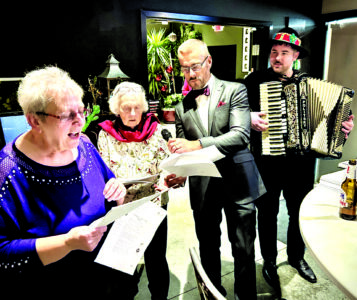
Correspondent photos / Thomas Welsh ... Sunday’s Wigilia concluded with a singalong of Polish Christmas carols, led by from left, Urszula Gerchak, vice president of the Polish Arts Club of Youngstown; Alexandria Copich, Damian Tarantino and accordionist Luke Politsky.
COLUMBIANA — For generations, Polish Americans have gathered with relatives and friends on Christmas Eve to share a meatless dinner known as Wigilia (“Vigil”). For many, the gathering is the most intimate and meaningful event of the Christmas season.
In recent years, the Polish Arts Club of Youngstown has opened its annual reenactment of Wigilia to the public to raise awareness of Polish culture and traditions.
On Sunday, the club celebrated its 90th Wigilia at Columbiana’s Sabi’s Restaurant, where attendees relived memories of the past or learned something new about an ethnic community that has contributed significantly to the Mahoning Valley’s rich culture.
Mary Ann Mlynarski, who serves as club president, recalled that when she was a child, celebrations took place every Christmas Eve at the home of her maternal aunt, Florence Turowski, the local educator who founded the Polish Arts Club of Youngstown in 1935.
The club’s official celebration of Wigilia, though, was held earlier in the month at Sacred Heart of Jesus Polish National Catholic Church, once located on Youngstown’s South Side.
“The dinner was prepared by ladies of the church,” Mlynarski said. “Even though it was limited to club members and their families, we had at least 100 people in attendance.”
Those days are gone. The Polish Arts Club of Youngstown, like many organizations, has seen membership decline amid trends that include depopulation, deindustrialization, and the growing tendency of young people to avoid joining groups.
“Now that we’re in our 90th year, though, our club is more committed than ever to keeping this tradition alive,” Mlynarski said.
Sunday’s well-attended Wigilia belied the perception that ethnic traditions are in steady decline. About 90 people filled the interior of Sabi’s restaurant, whose Polish-born owner, Sebastian Chomczyk, arrived in the Mahoning Valley as a youngster in 1992.
Although Sabi’s menu is eclectic, ranging from Asian to Eastern European cuisine, Chomczyk enjoys preparing Polish food for Wigilia, which was a low-key religious holiday in the Communist-ruled Poland of his childhood.
Traditional delicacies at the event included herring fillets, potato pancakes with applesauce, mushroom and grain stuffed cabbage, broiled and fried cod, pierogi, braised red cabbage, poppyseed noodles and a rich mushroom soup known as krupnik. “We Polish are all about food,” Chomczyk said, laughing.
Sunday’s festivities opened in the late afternoon with appetizers and cocktails. Attendees received an official welcome from club secretary Lisa Lotze, who stressed the importance of ethnic traditions.
Lotze said her own children tap into the area’s “ethnic vibe” whenever they return to Ohio from Washington, D.C.
“When you live in a city with a transient population, you lose some of the history that helps to ground you,” she said.
A blessing for the meal was delivered by the Rev. Joseph Rudjak, a retired diocesan priest who grew up in the Polish community of Youngstown’s Brier Hill District.
Rudjak described the holiday tradition of sharing Oplatek, a wafer baked in the shape of a holy card. Participants in the dinner exchange pieces of the wafer among themselves, and Oplatek are mailed to relatives who cannot be present at a celebration.
The tradition seemingly grew out of the excitement children experienced as Christmas Eve dinner approached. “The smell of baking bread was wonderful,” Rudjak said. “So, mothers began to spread a thin layer of dough across the bottom of the oven so that their kids could enjoy a special treat.”
Parents started to bless the Oplatek, which eventually became a tradition. Its importance in Poland was paramount. Indeed, the sharing of Oplatek between a landlord and peasant worker served as a “binding contract,” Rudjak said.
Other holiday traditions abound. Club member Marta Mazur, owner of Boardman’s Krakus Bakery, shared an early memory of Christmas Eve in her native Poland.
“Most of us were busy pinching pierogi that night,” she recalled. “But there was always the anticipation of the youngest child, who looked out the window for the first star. Wigilia, after all, begins with the appearance of the first star.”
This tradition is symbolized by the star-shaped paper ornaments (Gwiazda) that are used to decorate Polish Christmas trees, said club treasurer Ken Giba. He noted that among others, club members produced dozens of handmade ornaments as favors for the event.
Meanwhile, Urszula Gerchak, vice president of the organization, said club members contributed homemade pastries for the event’s cookie table. Attendees also had a chance to participate in a silent auction, basket raffle, and 50 / 50 drawing. Prizes included specialty items from Poland.
Sunday’s event concluded with an energetic singalong of Polish Christmas carols (Kolendy) led by Damian Tarantino. The product of a Polish and Italian household, Tarantino served as choir director of the former St. Casimir Catholic Church between 1996 and 2012, when the ethnic parish closed in a merger with St. Columba Cathedral.
“The loss of ethnic institutions, including churches, has left ethnic communities without a voice — literally,” Tarantino said. “Think of all the beautiful Polish carols that were once preserved in churches and are now in danger of being lost. Events like this are not only important for the preservation of the history of the area’s Polish American community, they’re critical to the preservation of local ethnic history in general.”
Special guests at the event included Jimmy Sutman, director of ISLE, Inc. and Purple Cat, businesses that provide services for adults with disabilities. The Polish Arts Club of Youngstown donated all extra food from the Wigilia to the Purple Cat.
Local News
Businessman, musician, judge to address YSU fall grads
YOUNGSTOWN — Youngstown State University will host three commencement ceremonies Friday and Saturday in the ...
Howards end: Warren men’s store to close
WARREN — The markdowns started Thursday when Howards Clothes announced it was ending operations after 75 years as ...
Man intentionally run over at Glenwood Avenue parking lot
YOUNGSTOWN — Surveillance video showed a person being hit by a car about 11:45 p.m. Sunday in the parking lot of ...
High court suspends attorney’s license over fraud conviction
YOUNGSTOWN — The Ohio Supreme has indefinitely suspended the law license of Anthony J. Fusco, 37, of Youngstown, ...
Volunteers step up to help SA’s Red Kettle campaign
Civil complaint filed against pilot, company in crash
HOWLAND — The estate belonging to a woman who died in a plane crash earlier this year has filed a civil complaint ...