

Stretch harvest with long gourds
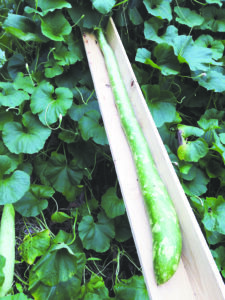
Mahoning County Master Gardener John Schoeni shows how he secures a long gourd to a board when it's ready to harvest. Drying takes several months. (Submitted photo / John Schoeni)
For the previous 20 years, I have grown numerous varieties of small, ornamental gourds in the garden for fall decorations. In 2020, I acquired long gourd seeds from a previous Pennsylvania long gourd record-holder. He gave me several seeds from a gourd he grew to 99 inches long!
I wanted to see how long of a gourd I could raise.
Long gourds (Lagenaria siceraria) originated in Africa and were spread to Europe, Asia and Americas over thousands of years. Many uses and variations of long gourds have evolved by selection by humans over the years.
Soil nutrient needs of long gourds are the same as most Cucurbit crops such as cantaloupe, cucumber, squash and pumpkins. Soil pH should be 6.6 to 7.0.
Germinating long gourd seeds is challenging. If starting indoors, cut the seed tip off, file edges and soak overnight in a damp paper towel placed inside a plastic bag in 80-degree heat for three days. You should see a small root starting to protrude. Plant seeds in a large pot and keep them in the 80-degree heat for three days.
I start seeds in mid-May, transplanting in June.
You will need a tall trellis, 10- to 12-feet high. I used 2-inch-by-4-inch old lumber and a 4-foot-by-8-foot wire cattle fence on two sides for an A-shaped trellis. The trellis should be in a full sun location with the planting side facing the south for maximum sun exposure.
I transplanted two plants on the south side and used heavy string to catch early tendrils. As the main vine climbed the trellis, I cut the secondary side vines to be no more than 2 feet long.
It is necessary to have an insect and disease control program in use to maintain good plant health. Organic production is more difficult, but either way it is important to apply sprays to both sides of the leaves. Water plants so that they receive at least 1 inch of water a week. Since I have the sandy loam soil, I water at least every two days when needed (when it doesn’t rain).
Long gourds flower at night with a beautiful white flower pollinated by moths. By mid-August you must reduce the number of gourds to five or fewer per plant. The gourds will be 3 feet long or less. Monitor growth. In two weeks, reduce to the two fastest-growing gourds. Plants will focus on maximum growth for these two.
If a gourd touches the ground, it will start to bend.
Here is the fun and amazing part of raising long gourds! I hang a tape measure beside gourds to record growth daily. It is common for long gourds to grow 3 to 6 inches a day!
In 2020, I had a gourd that grew 9 inches in 24 hours. WOW. The gourd grew to 113 inches and stopped suddenly. In 2021, my longest gourd was 119 inches. The Ohio long gourd record is 154.06 inches and world record is 173.75 inches.
Harvest long gourds when stem attached to the fruit begins to brown. Due to fragility, I use a 1-inch-by-6-inch wood board 6 inches longer than the gourd for securing. Place behind gourd and secure with strips of soft cloth before cutting stem to over 3 inches long. Wipe with a household disinfectant to destroy decaying organisms.
Dry or cure gourds by placing in a warm, dry, well-ventilated location. I use the rafters of my pole building near a ceiling fan. Gourds will be dry in several months.
For more information on growing long gourds and other ornamental gourds, go to http://go.osu.edu/ornamentalgourds .
Schoeni is an Ohio State University Extension Master Gardener Volunteer in Mahoning County.
Lifestyles
Flu or COVID-19? A test will tell you which one it is
Q. Last weekend, I was at a party in an apartment packed with people, and two days later, symptoms of the flu came ...

Tuesday evening TV listings
Beating the winter blues
The Nordic countries are no strangers to the long, dark winter. Despite little to no daylight — plus months of ...
TO YOUR GOOD HEALTH: Dye in CT scans can aggravate thyroid
DEAR DR. ROACH: I am a male who is 58 years of age. I recently had an MRI of my cervical spine, and just this ...
Bridge by Steve Becker
Assume you’re East, defending against three notrump, and West leads the jack of spades. Declarer wins with the ...
HINTS FROM HELOISE: Avoid paper to wrap all holiday gifts
DEAR HELOISE: We’ll be spending hours wrapping Christmas and Hannukah gifts in a few weeks, using a lot of paper ...