The best options for ground cover
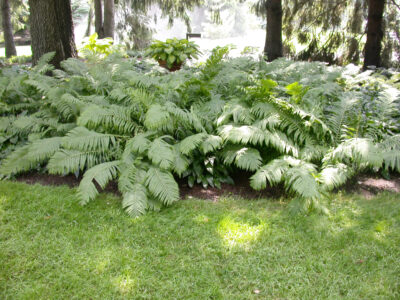
Matteuccia struthiopteris ä the ostrich fern ä is about 2 to 3 inches tall and works well as a ground cover. (Submitted photo / David Gardner)
Q: What is my best option for a ground cover?
• Linda from Cornersburg
A: We love that you are asking about the “best option,” because there are many good options but many options that are not worth the hard work and money to plant in your landscape.
We all desire vegetation to cover parts of our landscape. We enjoy their beauty, the steady work at making things look neat and tidy, and many times, their year-round interest.
But many plants which are known as typical ground covers are not good options. Some are invasive like English ivy, vinca vine and even Japanese pachysandra.
Let’s talk about what is a ground cover and what are some of the best options.
The term ground cover in general suggests the plant grows quickly and takes over an area. So most plants suggested as ground cover can become a problem. Many of these are not completely invasive, but they can be a challenge to contain. Many of them spread quickly through nodes touching soil or by seed production. They easily move to another area by accident.
One plant you may never have thought about as a ground cover is the climbing hydrangea. While it is beautiful as a climbing vine, it is exquisite as a ground cover. The May to June bloom time has the plant covered in white, lacecap blooms which are favored by pollinators. The peeling bark effect on the branches and laterals have winter interest and give a ripples and waves effect with varying high and low areas as the vine grows. There is a variegated option with lime green edging on the leaf for even more interest throughout the year.
To learn more about this plant, go to http://go.osu.edu/climbinghydrangea.
For native options, there are a variety of ferns, Canadian ginger, crested iris, moss phlox and foam flower.
For something evergreen or even something a little taller, try blue star juniper or hydrangea arborescens “Invincibelle Wee White” that stays less than 2 inches tall in many plantings.
Choose wisely when choosing a ground cover. Visit gardens and parks to see what is working for others. Ask the experts before making a decision. Consider short perennial plants for borders, versus something that spreads fast.
For a list of alternative plants for ground covers, see: http://go.osu.edu/ground covers This is the best information sheet available, and it includes many native and deer resistant plants as options. There are even links to see the plant as a ground cover.
Barrett is the Ohio State University Extension educator for agriculture and natural resources in Mahoning County. Barb Delisio, Master Gardener Volunteer Emeritus contributed to this answer. The Plant and Pest Clinic is open for help with plant issues, soil testing and insect identification. Winter hours vary. For details, visit go.osu.edu/maho
ningclinic or call 330-533-5538.
Lifestyles
Religion news
MEMORIAL DAY MASS: St. John the Baptist Cemetery, 3900 Villa Marie Road, Lowellville, will celebrate a Memorial Day ...
Pope, co-founder of Anthropic to launch pontiff’s AI encyclical
ROME (AP) — Pope Leo XIV and the co-founder of artificial intelligence company Anthropic will launch the ...
Community eats up one man’s desire to serve
To Your Good Health: CAC scan can indicate heart risk
DEAR DR. ROACH: I’m 67 and in decent shape. I run 3-4 miles three times a week and lift weights three days a ...

Bridge by Steve Becker